The GCC depends on imports for up to 85% of its food. Egypt holds 4.5M tonnes of wheat reserves. Sweden is stockpiling 3,000 calories per citizen. Food security anxiety is reshaping global import demand. Here is India's role in this new order.
Something has changed in how governments and large organizations think about food imports. For the past three decades, the dominant assumption was that global trade would reliably supply food to import-dependent nations - that comparative advantage, open shipping lanes, and price competition would always ensure that food was available from somewhere at a reasonable cost. The events of 2025 and 2026 have broken that assumption, and the response is now visible in government policy, corporate procurement, and investment decisions across every major food-importing region.
Sweden has set aside $63 million to re-establish emergency food stockpiles, with plans to bank enough for each citizen to have 3,000 calories per day for a year. Finland and Norway are rebuilding national food reserves. Egypt is maintaining 4.5 million tonnes of wheat reserves. Qatar has reinforced long-term grain stockpiles. Countries from Bangladesh to Brazil to Indonesia have introduced emergency measures to manage rising fuel and food costs. And in the GCC - the world's most import-dependent food region, where some nations source up to 85% of their food from abroad - a structured, phased food security transformation program is now underway.
The global food security crisis 2026 is not primarily a production shortage. Global agricultural production capacity remains substantial. It is a supply chain security crisis - a recognition that production capacity in one country and consumption in another are only reliably connected when shipping lanes are open, fertilizer is available, and geopolitical conditions allow normal trade. When those conditions break down simultaneously, as they did in early 2026, the fragility of import-dependent food systems becomes uncomfortably visible.
For food importers, this shift creates something new: a buyer category that is not primarily motivated by price, but by reliability, proximity, and political safety. Understanding this buyer and what it requires from food exporting nations is the most important strategic insight available to Indian food exporters right now.
The Scale of Import Dependence | Why This Matters So Much
The numbers behind GCC food import dependence make the current situation stark. The Strait of Hormuz handles 81% of the GCC's rice imports, predominantly arriving from India. Approximately 35% of GCC grain imports pass through the Strait. Some GCC nations depend on imports for up to 85% of their food supply. When the Strait closed on February 28, 2026, and maritime traffic collapsed by approximately 97% within days according to Asafi's March 2026 analysis, this was not an abstract geopolitical event for Gulf consumers - it was a direct threat to daily food supply.
UAE shoppers reported rising prices for fruits and vegetables within weeks of the closure. Kuwait's local fish markets were affected. The GCC's wealth - which allowed it to build grain silos, fund strategic reserves, and invest in agritech - bought time, but not immunity. The IMF has warned that trade fragmentation could reduce global GDP by approximately 7%. For the GCC, which combines extreme import dependence with the Gulf's own role as a major fertilizer exporter, the food security stakes are particularly high.
But the GCC is not alone. The FAO's Chief Economist gave a UN briefing warning that the Hormuz disruption triggered "one of the most severe shocks to global commodity flows in recent years." Countries identified as most vulnerable included Sri Lanka during its Maha rice harvest, Bangladesh during its critical Boro rice season, and Egypt due to its wheat import reliance. The fertilizer dimension amplified the food security concern beyond the immediately affected countries: around 1.3 million tonnes of fertilizers per month cannot transit through the Strait, with no viable land-based alternative - directly affecting agricultural production costs in Brazil, Bangladesh, India, Pakistan, and across sub-Saharan Africa.
How Governments Are Responding | The Strategic Reserve Build
The policy response to food supply chain vulnerability has been immediate and consistent across geographies - and it signals a durable structural shift in how import-dependent nations will manage food procurement going forward.
Strategic reserve building is the most visible response. Egypt has maintained 4.5 million tonnes of wheat reserves. Qatar reinforced long-term grain stockpiles. Vietnam aims to increase petroleum reserves to 90 days by 2030 as a proxy for energy-food security integration. Sweden's $63 million emergency food stockpile program is explicit in its objective: enough calories for every citizen for a full year, on domestic soil, regardless of what happens to shipping lanes.
Supply chain diversification requirements are being written into government procurement frameworks. GCC nations with decades of single-corridor import dependence - routing food from India through the Strait of Hormuz - are now explicitly requiring that procurement strategies identify and qualify alternative routing options. DP World's port investment strategy in Africa and ASEAN, which had previously been driven by commercial return, is now being accelerated by food security logic.
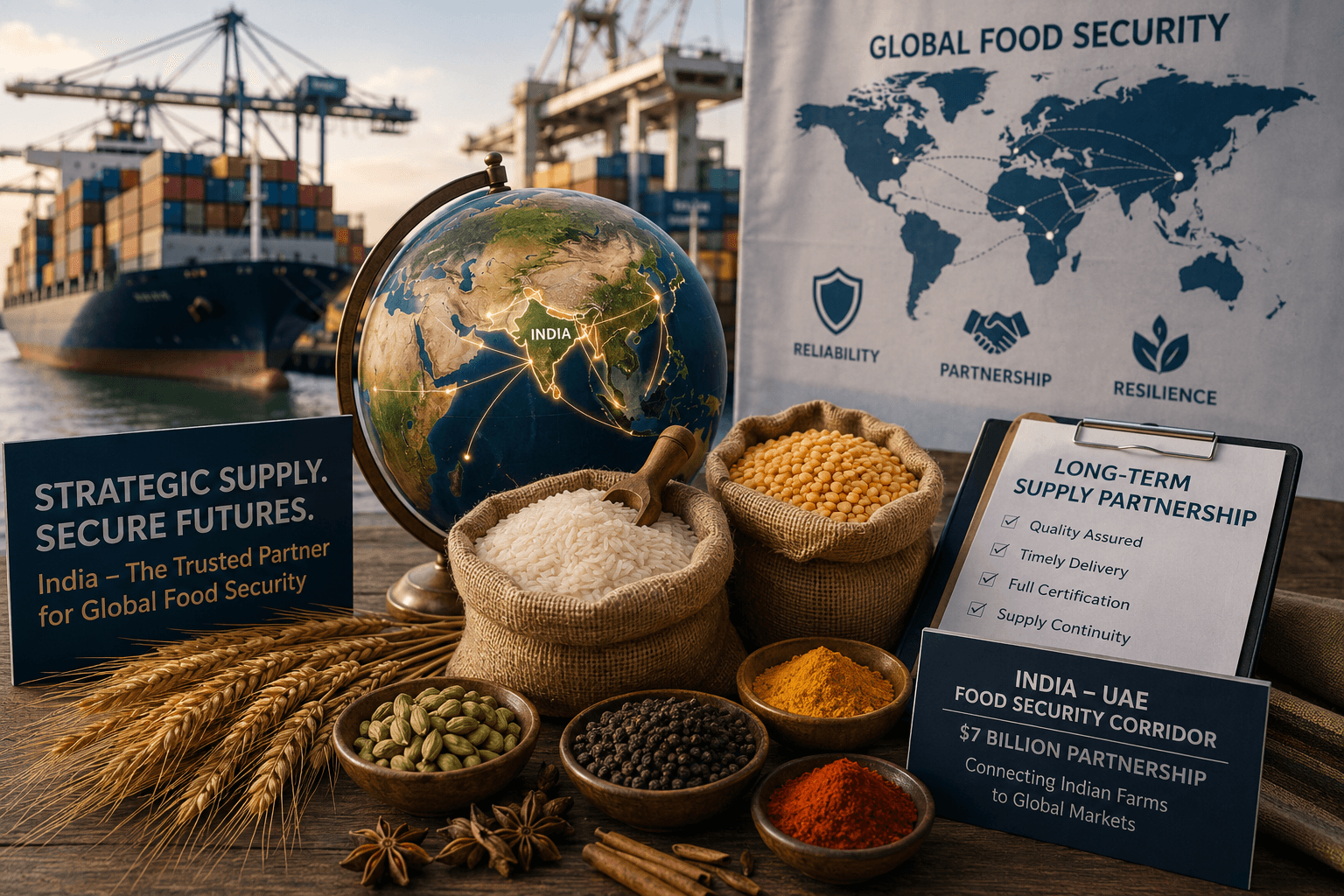
Long-term supply partnership agreements are replacing spot-market procurement for strategic food categories. The UAE and India's $7 billion food security corridor agreement under the India-UAE CEPA is the most prominent example - connecting Indian farms directly to UAE ports under a framework that prioritizes supply continuity over price optimization. Similar structured partnership frameworks are being developed across the GCC-South Asia corridor in response to the current crisis.
Domestic production investment is being scaled, even in geographies where climate and resource constraints make domestic food production inherently expensive. Saudi Arabia, the UAE, and Qatar are all scaling agritech, controlled-environment agriculture, and precision farming investments. These investments do not aim to replace imports - they aim to reduce the proportion of critical food supply that is entirely dependent on foreign supply chains.
The GCC's three-phase food security transformation program is explicit in its ambition: Phase 1 (2026) focuses on emergency stabilization, Phase 2 (2026-2028) on structural transformation and regional integration, and Phase 3 (2028-2030) on positioning the Gulf as "a preferred global partner and leader in adaptive food security management." This is not crisis management. It is a decade-long strategic program.
Why India Is the Answer to Strategic Food Security Demand
The requirements of a strategic food security importer are fundamentally different from those of a price-driven commercial buyer. They need reliability over price. They need proximity in supply chain terms - short transit times, established logistics, and minimal choke-point dependence. They need political safety - a supplier country that is not a geopolitical adversary, not subject to export bans, and not dependent on vulnerable supply chains itself. And they need depth - the ability to supply at scale, consistently, across multiple food categories, year after year.
India meets all four requirements more completely than any other major food-exporting nation.
Reliability. India's agricultural production infrastructure is the world's largest for multiple categories: basmati rice (89% of global supply), spices (45% of global trade volume), lentils and pulses (among the world's largest producers and exporters). The depth of India's production base provides the supply reliability that strategic buyers require. India does not depend on a single crop, a single region, or a single season. When monsoon conditions are difficult in one state, production in others provides a buffer.
Proximity in supply chain terms. India's western coast ports - Mundra and Nhava Sheva - sit at the gateway of the Indian Ocean, positioning Indian exports for direct, efficient routing to the Gulf (12 to 18 days), East Africa (12 to 18 days), South Asia (5 to 10 days), and Europe via Cape of Good Hope (25 to 35 days). India received a Strait of Hormuz transit exemption from Iran during the 2026 conflict - demonstrating that India's routing options are more flexible even in extreme disruption scenarios than those available to most competing origins.
Political safety. India is not in a trade dispute with the GCC, the EU, the US, or any other major food-importing region. It is not subject to export sanctions. It has no history of weaponizing food exports as a geopolitical tool - unlike Russia, which has used wheat as a strategic instrument, or China, which has restricted agricultural exports during trade disputes. India's strategic autonomy - its ability to maintain relationships across geopolitical blocs - makes it the safest possible origin for buyers whose food security planning depends on supply continuity regardless of geopolitical shifts.
Production depth and category breadth. India supplies rice, lentils, pulses, spices, processed foods, sugar, tea, coffee, fruits, and vegetables - a range that covers the core of any nation's food import basket. No other single origin provides this breadth at India's price point and quality level. For buyers building strategic supply partnerships that cover multiple categories, India is the only single-origin option that avoids the concentration risk of single-category dependence.
The India-GCC Food Security Corridor | A Model for Others
The India-UAE $7 billion food security corridor established under the CEPA is the most developed model of what strategic food import partnerships look like in practice. It connects Indian farms directly to UAE port logistics infrastructure, with pricing and supply continuity commitments that go beyond normal commercial contracts. The UAE benefits from supply reliability and pricing predictability. India benefits from volume commitment and market access that justifies agricultural investment.
This model is being replicated and extended. Qatar, Saudi Arabia, Kuwait, and Bahrain are all in various stages of formalizing long-term food supply partnership frameworks with Indian counterparts. The FAO's April 2026 agrifood policy highlights that Egypt is maintaining large wheat reserves partly because of long-term supply agreements with reliable origins - and India is among Egypt's most significant food trading partners.
For food importers in any region who are facing government or board-level pressure to demonstrate supply chain resilience for their food procurement, the India-GCC food security corridor model offers a template: long-term volume commitments at negotiated prices, routing through India's established port infrastructure, full documentation compliance with destination-market requirements, and supply continuity commitments backed by India's production depth rather than a single farm or single state's harvest.
What This Means for Import-Dependent Buyers Right Now
The food security import strategy that works in the current environment prioritizes three things that pure price optimization does not.
Long-term supply agreements over spot purchasing. The strategic reserve building that governments are undertaking requires long-term volume commitments - and the suppliers who can fulfill those commitments are the ones building partnership-level relationships now, not competing on spot price at harvest. For corporate importers, the same logic applies: a supplier with a documented, tested long-term relationship provides supply continuity insurance that spot-market procurement cannot.
Multi-corridor routing capability. The Hormuz crisis demonstrated that buyers whose food supply depended on a single maritime corridor were maximally exposed. Indian exporters who can route via Cape of Good Hope, direct to East African ports, or via the Arabian Sea depending on conditions offer routing flexibility that single-corridor supply chains cannot. Verify your supplier's logistics network before a crisis makes it urgent.
Documentation and certification infrastructure. Strategic food buyers - whether government agencies, large retailers, or institutional food processors - require documentation standards that casual commercial buyers often do not. FSSAI certification, phytosanitary certificates, certificates of analysis, halal certification where required, and now CETA/FTA-compatible origin documentation for UK and EU buyers. India's export documentation infrastructure is among the most developed in the world for the food categories it leads in.
At Bayharbor Exports, we supply Indian rice, spices, lentils, pulses, and processed foods to importers across the GCC, Europe, Africa, and beyond - with the full certification and documentation stack that strategic buyers require, and logistics arrangements adapted to current routing realities. For buyers building food security supply chain partnerships, we are ready to discuss long-term supply arrangements.
Our blog on how geopolitics is rewiring global supply chains covers the broader strategic context of which India's food security role is a part.