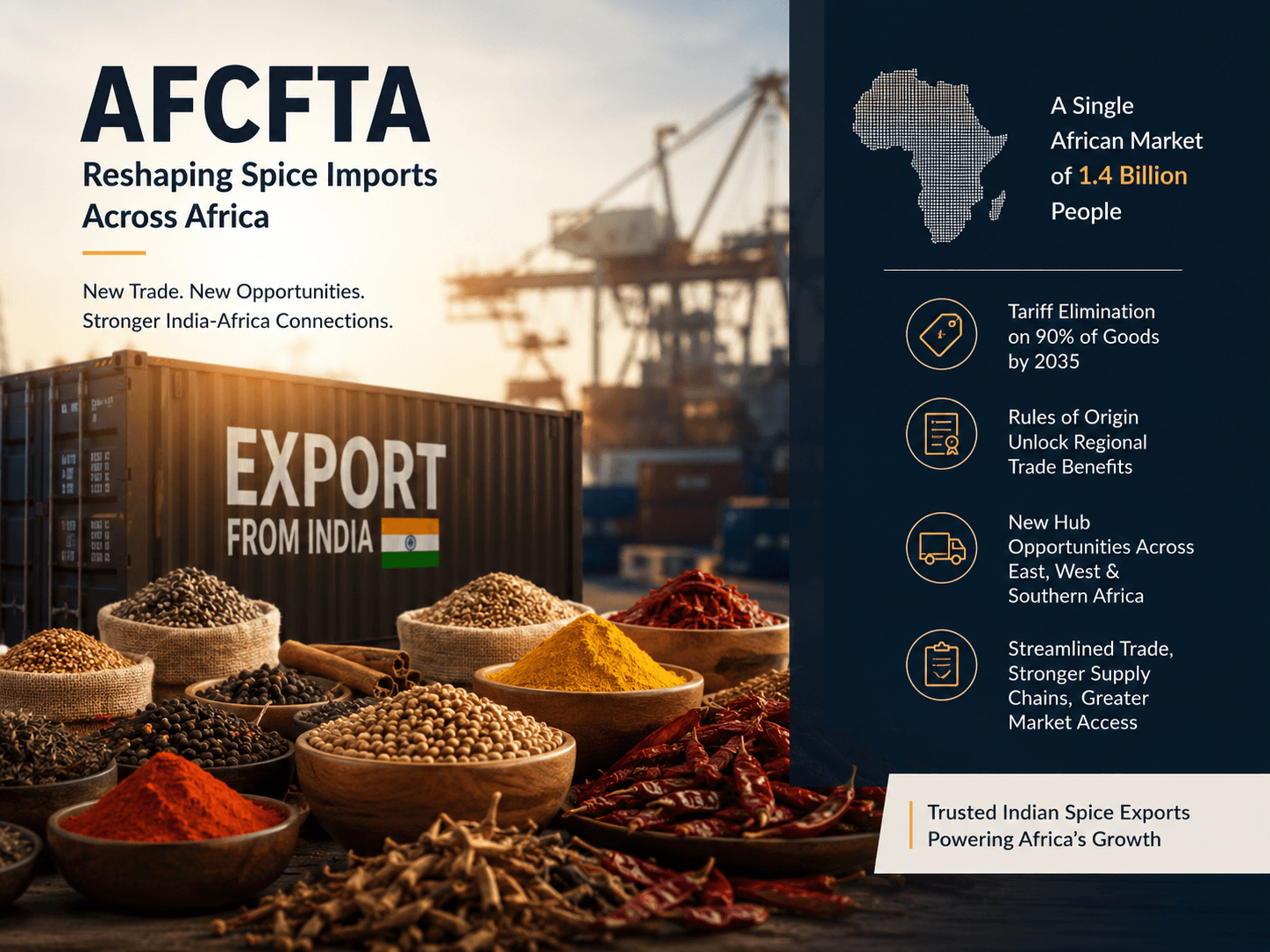
The AFCFTA is transforming the way African spice importers source, process, distribute, and price Indian spices across regional markets. From tariff elimination and rules of origin to documentation and regional hub strategies, buyers must understand how this trade framework is reshaping the India-Africa spice supply chain.
How the AFCFTA Is Reshaping Spice Imports Across Africa | What Buyers Need to Know
The African Continental Free Trade Area is the largest free trade agreement in the world by the number of participating countries. Fifty-four African Union member states have signed it. As of February 2025, ten countries including Ghana, Kenya, Rwanda, Tanzania, Mauritius, Egypt, Cameroon, South Africa, and Nigeria were actively trading goods under the AfCFTA's Guided Trade Initiative. Phase-down of tariffs on Category B goods began January 1, 2026. And the agreement's long-term ambition is unambiguous: to create a single African market of 1.4 billion people with a combined GDP of $3.4 trillion, where goods move across borders with dramatically lower friction than today.
For spice importers across Africa who source from India, the AFCFTA is not an abstract trade policy development. It is changing the commercial logic of where you land your Indian cargo, how you structure distribution agreements, how you price across regional markets, and what documentation your supply chain needs to function efficiently as the agreement deepens. This blog breaks down what the AFCFTAmeans specifically for the India-Africa spice trade and what buyers should be doing to position themselves ahead of the market structure it is creating.
What the AFCFTA Actually Does ~ The Mechanics
The AFCFTA has two primary operating mechanisms that affect African spice importers sourcing from India.
Tariff Elimination Between Member States
Under the AfCFTA, member states are progressively eliminating tariffs on goods traded between them. For most categories of goods, the phase-down schedule runs from 2021 to 2035, with 90% of tariff lines moving to zero duty within the first five years for most countries. Category B "sensitive" goods - which include some agricultural products - are on a longer phase-down schedule, with tariff reductions beginning January 1, 2026.
The direct implication for spice importers: goods that enter an AFCFTAmember state as imports from India - and are then processed or packaged sufficiently to qualify as originating from that state under AFCFTArules of origin - can move to other African member states at zero or reduced tariff. This is the mechanism that Dubai has used for decades as a re-export hub, and that several East and West African ports are now developing as value-addition platforms.
Rules of Origin
AfCFTA's Rules of Origin determine which goods qualify for preferential tariff treatment when moving between member states. For processed goods, sufficient transformation - typically adding value through processing, blending, or packaging - can qualify imported inputs as AfCFTA-originating once processed in a member state. For importers who receive bulk Indian spices and process, blend, or repackage them in an AFCFTAmember country, the finished product may qualify for preferential intra-AFCFTAtariff treatment when distributed to other member states.
This is a meaningful commercial opportunity. A Nigerian spice blender importing bulk turmeric, cumin, and coriander from India can potentially distribute finished blended spice products to Ghana, Senegal, or Cameroon under AFCFTApreferential rates - reaching West African consumers more competitively than importers who source finished products from outside Africa entirely.
The Guided Trade Initiative | How It Works in Practice
The AfCFTA's Guided Trade Initiative (GTI) is the operational pilot phase of the agreement, launched in Accra, Ghana in October 2022 and concluded at the 16th Council of Ministers Meeting in April 2025. During the GTI, ten participating countries established the institutional infrastructure for AFCFTAtrade flows: verification procedures, customs processes, certificate of origin issuance, and cross-border logistics protocols.
The GTI's conclusion and transition to broader AFCFTAimplementation 2026 means the systems tested during the pilot are now being rolled out to the full member state base. For spice importers, this matters because the documentation infrastructure for proving AFCFTAorigin - certificates of origin linked to AFCFTArules of origin - is now operational in the pilot countries and being extended progressively.
India's relationship to the AFCFTAis indirect but strategically important. India has bilateral trade agreements with multiple African nations and operates the Duty-Free Tariff Preference (DFTP) Scheme for least-developed African countries. As AfCFTA's intra-African trade deepens and harmonizes standards, India's position as the primary external spice supplier to the continent becomes more strategically valuable - because a consistent, certified Indian supply base is the raw material that AfCFTA's intra-African value chains will process, blend, and distribute.
The Strategic Logic for Indian Spice Importers in Africa
The AFCFTAcreates a new commercial geography for Indian spice distribution in Africa. The old model - landing a shipment in one country's port and selling domestically - is giving way to a regional hub model where entry at a well-positioned port can serve multiple national markets.
1East Africa: Kenya as the Regional Hub
Kenya's Mombasa port is 12 to 18 days from Indian ports - the shortest transit on any India-Africa route. Kenya is a GTI participant with established AFCFTAcompliance infrastructure. For Indian spice importers serving East Africa, landing cargo at Mombasa and distributing under the East African Community (EAC) preferential framework to Uganda, Tanzania, Rwanda, and Burundi is the logical hub-and-spoke model. The EAC's own internal tariff framework - which predates AFCFTAand already operates with near-zero intra-EAC duties on most goods - provides the existing distribution backbone that AFCFTAis building on.
West Africa: Ghana as the Anglophone Hub
Ghana's Tema port is West Africa's most efficient container facility and a participant in the GTI. For Indian spice importers targeting West Africa's large Anglophone market, Ghana offers port efficiency, political stability, and distribution reach into Nigeria, Ivory Coast, Senegal, and beyond. Nigeria's Apapa port is heavily congested and slower to clear, making Ghana an attractive alternative landing point for cargo bound for the wider West African market.
South Africa: High-Value Market, Strict Compliance
South Africa is not a regional hub in the distribution sense - it is an end market in its own right, and Africa's most sophisticated one. The modern retail chains that dominate South African grocery - Shoprite, Pick n Pay, SPAR, Woolworths - have quality and documentation requirements that match European retail standards. For Indian spice exporters to South Africa, this means BRC or ISO 22000 certification, complete certificates of analysis, and consistent quality across shipments are baseline requirements, not premium features.
The Documentation Challenge | What AFCFTAMeans for Your Paperwork
The AfCFTA's preferential tariff framework only works if documentation is correct. For spice importers building supply chains that span multiple African markets, this introduces a documentation layer that didn't exist in single-country import operations.
Certificate of AFCFTAOrigin
To claim preferential tariff treatment under the AfCFTA, goods must be accompanied by an AFCFTACertificate of Origin issued by a competent authority in the exporting member state. For goods processed or packaged in an AFCFTAmember state from imported inputs (like Indian spices), the certificate of origin must confirm that sufficient processing was carried out to meet the AFCFTArules of origin threshold for the product category.
For importers receiving Indian spice inputs and processing them in an AFCFTAmember state, confirming the specific rules of origin threshold for your product's HS code is an essential first step - and one to resolve with your customs agent before the first cross-border shipment rather than after.
India Side Documentation Compatibility
Indian-origin inputs entering the AFCFTAsupply chain need the full standard documentation stack: phytosanitary certificate, certificate of analysis, FSSAI certification, APEDA registration certificate, and a certificate of origin confirming Indian origin. The Indian certificate of origin is a distinct document from the AFCFTAcertificate of origin issued at the African processing point - importers need to understand that both documents serve different purposes in a multi-hop supply chain.
Harmonized Standards | Work in Progress
One of the AfCFTA's longer-term goals is to harmonize food safety and quality standards across African member states. As of 2026, this harmonization is still a work in progress. South Africa's SABS standards, Kenya's KEBS standards, Nigeria's NAFDAC requirements, and Egypt's GOEIC procedures remain country-specific. For spice importers distributing across multiple African markets, this means country-specific compliance management is still required - AFCFTAdoes not yet eliminate the need to understand each destination market's individual requirements.
The India Africa Bilateral Trade Framework
Alongside AfCFTA, India operates the India-Africa Duty-Free Tariff Preference (DFTP) Scheme for least-developed and developing African countries. The DFTP Scheme provides preferential tariff rates for eligible Indian exports to qualifying African nations, reducing the landed cost of Indian goods in participating markets. For spice importers in eligible countries, verifying whether their country qualifies under the DFTP framework and whether the specific spice HS codes they import are covered is worth checking with a customs agent - it can meaningfully reduce duty costs on direct India-to-country imports.
India-Africa bilateral trade exceeded $80 billion in 2023 to 2024. South Africa, Tanzania, and Nigeria are India's top three African trading partners. This bilateral trade volume has created an established infrastructure of freight agents, customs brokers, banking relationships, and logistics providers who are familiar with the India-Africa trade corridor - infrastructure that benefits importers on both sides of the transaction.
What AFCFTAMeans for Your Sourcing Strategy Right Now
The practical actions for African spice importers in 2026:
Map your distribution geography. If you currently import into one country and sell domestically, assess whether your volume and product range would benefit from a regional hub approach under the AFCFTAframework. If yes, identify which port offers the best combination of transit time from India, port efficiency, and AFCFTAcompliance infrastructure for your target regional market.
Understand your rules of origin position. If you process or blend Indian spices before distribution, confirm whether your processing qualifies for AFCFTAorigin status under your product category's specific threshold. This determines whether your finished goods can move across African borders at preferential rates.
Build documentation systems now. The administrative requirements for AFCFTAspice trade compliance are more complex than single-country import operations. Building the systems - certificate of origin management, AFCFTAdocumentation workflow, country-specific compliance file per destination market - before you scale to regional distribution is cheaper than retrofitting them after the fact.
At Bayharbor Exports, we supply bulk Indian spices for African distributors and processors - turmeric, cumin, coriander, chili, pepper, cardamom, and fenugreek - with the full Indian-origin documentation stack that AFCFTAsupply chains require. We work with experienced freight forwarders on India-to-Africa routes and understand the documentation requirements of Nigeria's NAFDAC process, Kenya's KEBS framework, South Africa's DALRRD system, and Ghana's GSA requirements.
Our complete guide to Africa's spice market opportunity covers the market size and demand picture in detail. For the logistics side of India-to-Africa shipping, our FCL vs LCL guide for importers covers the freight method decision.