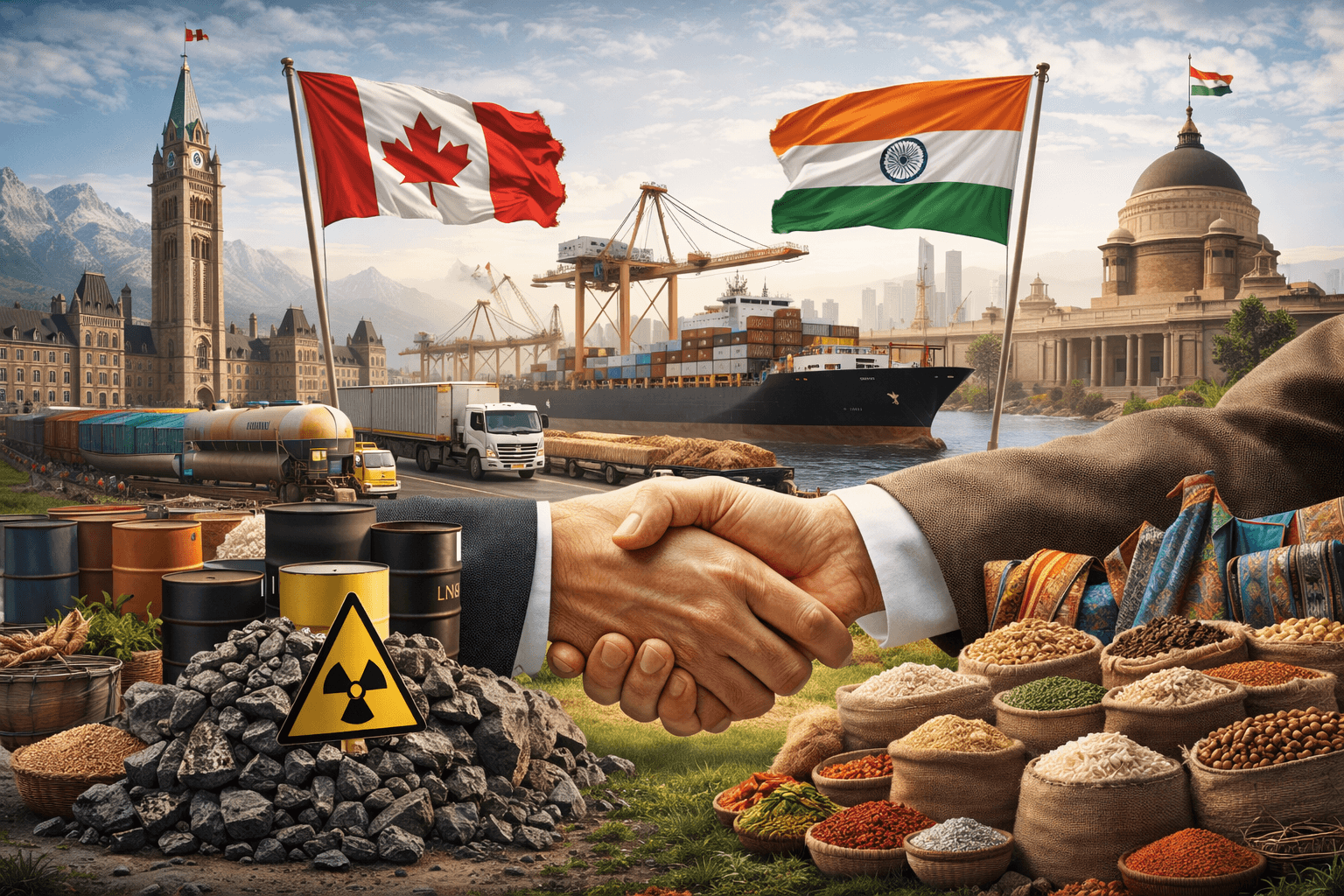
India-Canada relations have flipped from the 2023 diplomatic crisis to a fast-moving 2026 trade reset. CEPA negotiations launch in March 2026, a C$2.8B uranium deal is ready, and both countries are targeting $50B in trade by 2030. Here’s what importers and exporters need to know.
India-Canada Trade Reset: From Diplomatic Crisis to $50 Billion Opportunity
The Remarkable Turnaround Nobody Expected
In September 2023, Canadian Prime Minister Justin Trudeau stood in Parliament and accused India of involvement in the killing of Hardeep Singh Nijjar, a designated terrorist and Khalistan separatist. The explosive allegation, made without presenting evidence, triggered the worst diplomatic crisis in India-Canada relations in decades. Diplomats were expelled from both countries, visa services froze, and bilateral trade negotiations ground to a halt. Business leaders in both nations watched helplessly as political tensions threatened to destroy commercial relationships built over generations.
Fast forward to February 2026, and the transformation seems almost miraculous. Canadian Prime Minister Mark Carney is preparing to visit India in early March to formally launch negotiations for a Comprehensive Economic Partnership Agreement (CEPA) targeting $50 billion in bilateral trade by 2030. A $2.8 billion uranium supply agreement is ready for signing. Twenty-one Canadian university presidents just completed a trade mission to India focusing on research collaboration and the $1.7 billion talent strategy. Energy Minister Tim Hodgson is coordinating on crude oil, LNG, and critical minerals cooperation. High commissioners have been fully restored, diplomatic staffing is expanding, and both nations are racing to conclude agreements on artificial intelligence, quantum computing, defense, and space cooperation.
The dramatic turnaround from diplomatic freeze to economic opportunity provides critical lessons for importers, exporters, and businesses worldwide about how leadership changes, geopolitical realities, and economic necessity can transform international relations remarkably quickly.
The Dark Days: How Politics Destroyed Trade (2023-2024)
Trudeau's Explosive Accusation
On September 18, 2023, Justin Trudeau told Canada's Parliament that his government was investigating "credible allegations" linking Indian government agents to the June killing of Hardeep Singh Nijjar outside a Sikh temple in Surrey, British Columbia. India immediately and vehemently denied the allegations, calling them "absurd" and "preposterous." India's Ministry of External Affairs designated the accusation as politically motivated, pointing to Trudeau's reliance on seats from constituencies with significant Sikh populations and his long-standing accommodation of Khalistan separatist elements in Canada.
The timing proved particularly damaging given that India had repeatedly raised concerns with Canada about anti-India activities by Khalistani groups operating from Canadian soil. India had designated Nijjar as a terrorist through the National Investigation Agency, and his activities supporting violent separatism in India's Punjab state were well-documented. From India's perspective, Canada's harboring of designated terrorists while simultaneously accusing India of extra-judicial killings represented an intolerable double standard.
The Diplomatic Freeze
The fallout was swift and severe. India expelled a senior Canadian diplomat, suspended visa services for Canadian citizens, and dramatically reduced diplomatic staffing at its High Commission in Ottawa. Canada reciprocated with expulsions of Indian diplomats. Trade negotiations that had been progressing toward a CEPA ground to a halt. Business delegations were canceled, and uncertainty paralyzed bilateral commerce as companies questioned whether existing contracts and relationships could continue.
The human toll extended beyond government-to-government relations. Indian diaspora communities in Canada, numbering approximately 1.8 million and contributing significantly to Canadian economy and society, found themselves caught between their heritage and their adopted home. Indian businesses operating in Canada and Canadian companies with India operations faced pressure from both sides. Students, researchers, and professionals saw opportunities evaporate as visa processing stalled and academic exchanges froze.
Economic Consequences
While bilateral trade volumes of approximately $8 billion continued at reduced levels, the growth trajectory flatlined. Canadian exporters of canola, lentils, potash, and other agricultural products faced uncertain market access to India's massive consumer base. Indian IT companies, pharmaceutical manufacturers, and textile exporters operating in Canada confronted political headwinds and reputational concerns. Most significantly, the crisis destroyed momentum toward concluding a free trade agreement that could have doubled bilateral commerce.
Canadian pension funds, among the world's largest institutional investors with over $2 trillion in assets under management, had been exploring substantial investments in India's infrastructure sector. These discussions froze as political uncertainty made risk assessment impossible. Similarly, Indian companies considering Canadian investments in critical minerals, technology, and manufacturing shelved plans pending political clarity.
The Leadership Factor: Why Carney Changed Everything
Trudeau's Electoral Defeat
Justin Trudeau's Liberal government faced mounting domestic challenges beyond the India dispute. Economic concerns including inflation, housing affordability, and cost of living dominated Canadian voters' attention. By late 2024 and early 2025, polling consistently showed Liberals trailing badly, and Trudeau's personal approval ratings hit historic lows. The April 2025 federal election delivered a decisive verdict, with Mark Carney's renewed Liberal campaign under new leadership securing enough seats to form government by promising pragmatic economic management and diplomatic reset.
Carney's Pragmatic Approach
Mark Carney brought unique credentials to the premiership. As former Governor of both the Bank of Canada and Bank of England, he possessed deep understanding of global financial systems, trade relationships, and economic interdependence. His background emphasized data-driven decision-making over ideological positioning, and his international experience made him comfortable engaging with diverse nations and political systems.
Carney quickly identified India as a critical strategic partner for Canada's economic future. With US-Canada relations facing uncertainty due to President Trump's "America First" policies including threats of 35% tariffs on Canadian goods, diversifying trade became imperative. India, as the world's fifth-largest and one of the fastest-growing economies, represented an obvious target for expanded commercial engagement.
Carney also recognized that accommodating Khalistani separatists in Canada, while perhaps politically convenient for winning specific constituencies, carried unacceptable costs in terms of India relations and economic opportunity.
The Johannesburg Reset
Carney's first meeting with Prime Minister Narendra Modi occurred on the sidelines of the November 2025 G20 Summit in Johannesburg, South Africa. The encounter marked a definitive turning point in bilateral relations. According to the official statement from Canada's Prime Minister's Office, Carney accepted Modi's invitation to visit India in early 2026, and both leaders agreed to formally launch negotiations for an "ambitious Comprehensive Economic Partnership Agreement (CEPA) encompassing goods, services, investment, agriculture and agri-food, digital trade, mobility, and other areas."
The Johannesburg meeting's significance extended beyond diplomatic niceties. Both leaders committed to expanding cooperation in defense and space, areas that had been unthinkable during the Trudeau freeze. The discussions demonstrated Carney's willingness to prioritize economic opportunity and strategic partnership over the politics of managing domestic constituencies, while Modi signaled India's readiness to move past the diplomatic crisis once Canada demonstrated seriousness about bilateral relations.
What's Happening Right Now: A Trade Reset in Fast Motion
Universities Canada Mission (February 2-6, 2026)
As concrete evidence of the relationship's rapid improvement, twenty-one university presidents from across Canada completed a mission to India from February 2-6, 2026. The delegation, led by Universities Canada, visited Goa, New Delhi, and Gujarat International Finance Tec-City (GIFT City) to advance India-Canada research collaboration and expand partnerships with industry. The mission builds on the $1.7 billion research and talent strategy announced in Canada's federal budget and advances the New Roadmap for Canada-India relations announced in October 2025.
The university mission reflects recognition that modern economic partnerships extend far beyond traditional goods trade. Technology transfer, research collaboration, talent mobility, and innovation ecosystems increasingly determine competitive advantage in knowledge-based economies. India's massive higher education sector, producing millions of STEM graduates annually, represents a strategic asset for Canadian universities and industries seeking research partnerships and talent pipelines.
Energy Minister's Visit and Sectoral Agreements
Canadian Energy Minister Tim Hodgson's visit to India in January and February 2026 focused on concrete sectoral cooperation. Hodgson described India as "the world's fastest-growing energy market" and emphasized Canada's commitment to diversifying its energy exports beyond the United States. Canada has substantial crude oil, liquefied natural gas (LNG), and uranium production capacity that aligns well with India's energy security priorities as it aims to reduce dependence on volatile Middle Eastern suppliers and meet growing domestic energy demand.
The energy discussions extend to critical minerals, where Canada possesses substantial reserves of lithium, cobalt, nickel, and rare earth elements essential for batteries, electric vehicles, and renewable energy technologies. India's "Make in India" initiative and domestic manufacturing push create demand for reliable critical mineral supplies. The convergence of Canada's resource endowment with India's processing capabilities and manufacturing ambitions creates natural synergies that the Trudeau freeze prevented from materializing.
The Uranium Deal: Energy Security and Nuclear Cooperation
A landmark 10-year uranium supply agreement worth C$2.8 billion (approximately $2 billion US dollars) is expected to be signed during Prime Minister Carney's March visit. The deal reflects India's aggressive nuclear energy expansion plans as it seeks to triple nuclear generation capacity by 2030 to meet climate commitments while maintaining energy security. Canada's uranium production capabilities, primarily from Saskatchewan mines, position it as a reliable long-term supplier meeting International Atomic Energy Agency safeguards requirements.
The uranium agreement carries broader significance beyond commercial value. Civil nuclear cooperation requires deep trust and confidence in non-proliferation commitments, regulatory frameworks, and long-term relationship stability. India's willingness to sign a decade-long uranium supply agreement signals confidence that the Carney government represents a reliable partner committed to sustained engagement rather than the political volatility that characterized the Trudeau years.
CEPA Negotiations Launch (March 2026)
The formal launch of CEPA negotiations during Carney's March visit represents the reset's centerpiece. Both sides are finalizing terms of reference for negotiations covering goods, services, investment, agriculture, digital trade, and mobility. Indian High Commissioner to Canada Dinesh Patnaik has expressed confidence that a CEPA could be concluded within one year of talks commencing, an ambitious timeline reflecting political will on both sides to move quickly.
The $50 billion bilateral trade target by 2030 represents more than doubling current trade volumes of approximately $24 billion. Achieving this goal requires addressing barriers including Canadian dairy and poultry supply management systems that restrict market access, Indian tariffs on Canadian agricultural products, and regulatory barriers in services sectors. The successful conclusion of India's FTA with the European Union in January 2026, where India offered its deepest tariff concessions to date covering 97.5% of EU exports, sets a high bar for Canada's negotiations.
What the CEPA Means for Importers and Exporters
Canadian Opportunities in India
For Canadian exporters, the CEPA promises improved market access to India's 1.4 billion consumers and rapidly growing middle class. Key sectors include agricultural products (lentils, canola, pulses, wheat), natural resources (uranium, potash, crude oil, LNG), critical minerals (lithium, cobalt, rare earths), technology and services (financial services, education, digital services), and manufactured goods (machinery, equipment, automotive components).
Canada's strength in sustainable agriculture, clean technology, and resource extraction aligns well with India's development priorities. Canadian expertise in cold chain logistics, food processing, and agricultural technology can support India's efforts to reduce post-harvest losses and improve agricultural value chains. Similarly, Canadian financial services, pension fund management, and insurance expertise addresses India's needs for sophisticated financial infrastructure as its economy matures.
Indian Opportunities in Canada
Indian exporters gain access to a developed market of 40 million relatively affluent consumers through the CEPA. Priority sectors include textiles and apparel, pharmaceuticals and generics, information technology services, automotive components, and engineered goods. India's competitive manufacturing in sectors like textiles, leather goods, and jewelry finds ready markets in Canada where consumers increasingly value authentic products and ethical sourcing.
Indian IT services companies, pharmaceutical manufacturers, and engineering firms already operate significantly in Canada but face barriers that CEPA provisions on services, investment, and professional mobility can address. Reducing regulatory complexity, improving credential recognition, and facilitating temporary entry for business persons and skilled professionals creates opportunities for expanded operations and deeper market penetration.
Supply Chain Diversification Benefits
Beyond sector-specific opportunities, the CEPA supports supply chain diversification strategies increasingly critical in today's geopolitically fragmented world. Canadian businesses seeking alternatives to concentrated Chinese sourcing find India an attractive option offering scale, quality capabilities, English language proficiency, and democratic governance. Similarly, Indian companies looking to reduce exposure to US-China trade war crossfire benefit from developing Canadian relationships and potentially using Canada as a North American manufacturing or distribution base.
The Red Sea shipping crisis, with Houthi attacks forcing costly rerouting around Africa, highlights the value of diversified trade relationships. While Canada-India maritime shipping also faces longer distances than Asia-Europe routes, the relationship offers insurance against over-dependence on any single trade corridor or partner. In an era of "friend-shoring" and "de-risking," Canada and India represent reliable partners for each other precisely because their strategic interests align without the complications of great power competition.
Regional Context: Learning from the EU-India Deal
India's FTA Momentum
The timing of Carney's India visit cannot be separated from broader context. India has emerged as one of the world's most active trade agreement negotiators, concluding its eighth FTA since 2021 with the January 27, 2026 EU agreement. This acceleration follows India's 2019 exit from the Regional Comprehensive Economic Partnership (RCEP), after which India pivoted toward bilateral agreements offering greater control over terms and reflecting India's specific priorities.
The EU-India FTA demonstrates India's willingness to offer substantial market access to strategic partners. The agreement grants the EU India's deepest tariff concessions to date, exceeding those in recent deals with the UK, UAE, and Australia. Sectors including automobiles, machinery, chemicals, and precious metals see significant liberalization. The deal also includes dedicated chapters for small and medium enterprises, regulatory cooperation, and sustainable development, providing templates for future Indian FTAs including potentially with Canada.
Canada's Competitive Disadvantage
Without preferential access, Canadian exporters face disadvantages versus competitors from the EU, UK, UAE, Australia, and potentially the United States if India-US trade tensions ease. For example, European machinery exporters benefit from tariff eliminations while Canadian competitors pay full MFN (most favored nation) rates, directly impacting price competitiveness. Similarly, Canadian agricultural products face tariffs that competitors from FTA partners avoid, eroding market share in India's growing food import market.
The competitive pressure extends beyond goods. EU firms gain preferential treatment for service provision, investment protection, and movement of professionals under the FTA's services and investment chapters. Canadian service providers and investors operate without these advantages, potentially losing ground to European competitors with equivalent capabilities but superior market access terms. The urgency of concluding a Canada-India CEPA stems partly from recognition that delay means permanent loss of market opportunities to competitors already benefiting from preferential access.
Why Partner with Bayharbor Exports During the Trade Reset
Product Range Supporting CEPA Sectors
Our product portfolio aligns well with sectors likely to see expanded trade under CEPA including premium basmati rice varieties (1121, Pusa, Sharbati), organic and conventional spices (turmeric, cumin, coriander, cardamom, black pepper), lentils and pulses (red lentils, yellow lentils, chickpeas), processed foods (ready-to-eat meals, snacks, traditional products), and textiles and light manufacturing.
As CEPA negotiations progress and tariff schedules are negotiated, we stay current on developments affecting specific product categories. We provide customers with information on how tariff reductions, quota allocations, and regulatory changes impact their sourcing decisions. Our goal is helping businesses position themselves to capture CEPA benefits from day one of implementation.
Reliable Supply During Transition
Trade agreement negotiations and implementation create uncertainty as businesses wait to understand final terms and effective dates. Bayharbor Exports provides reliable supply during this transition period, ensuring customers maintain inventory and market presence regardless of negotiation timelines. We manage risk so our customers can focus on building their businesses rather than worrying about supply disruptions.
As CEPA implementation proceeds, we adapt our operations to leverage new opportunities including streamlined customs procedures, reduced tariffs improving margins, regulatory mutual recognition facilitating faster market entry, and enhanced trade facilitation measures. Our commitment is being the partner that makes CEPA work practically for your business.
Ready to position your business for the India-Canada trade opportunity?
Contact Bayharbor Exports today to discuss how improved relations and upcoming CEPA create opportunities for Canadian businesses sourcing Indian products.
Bayharbor Exports - Your Bridge Between India and Canada in a New Era of Partnership