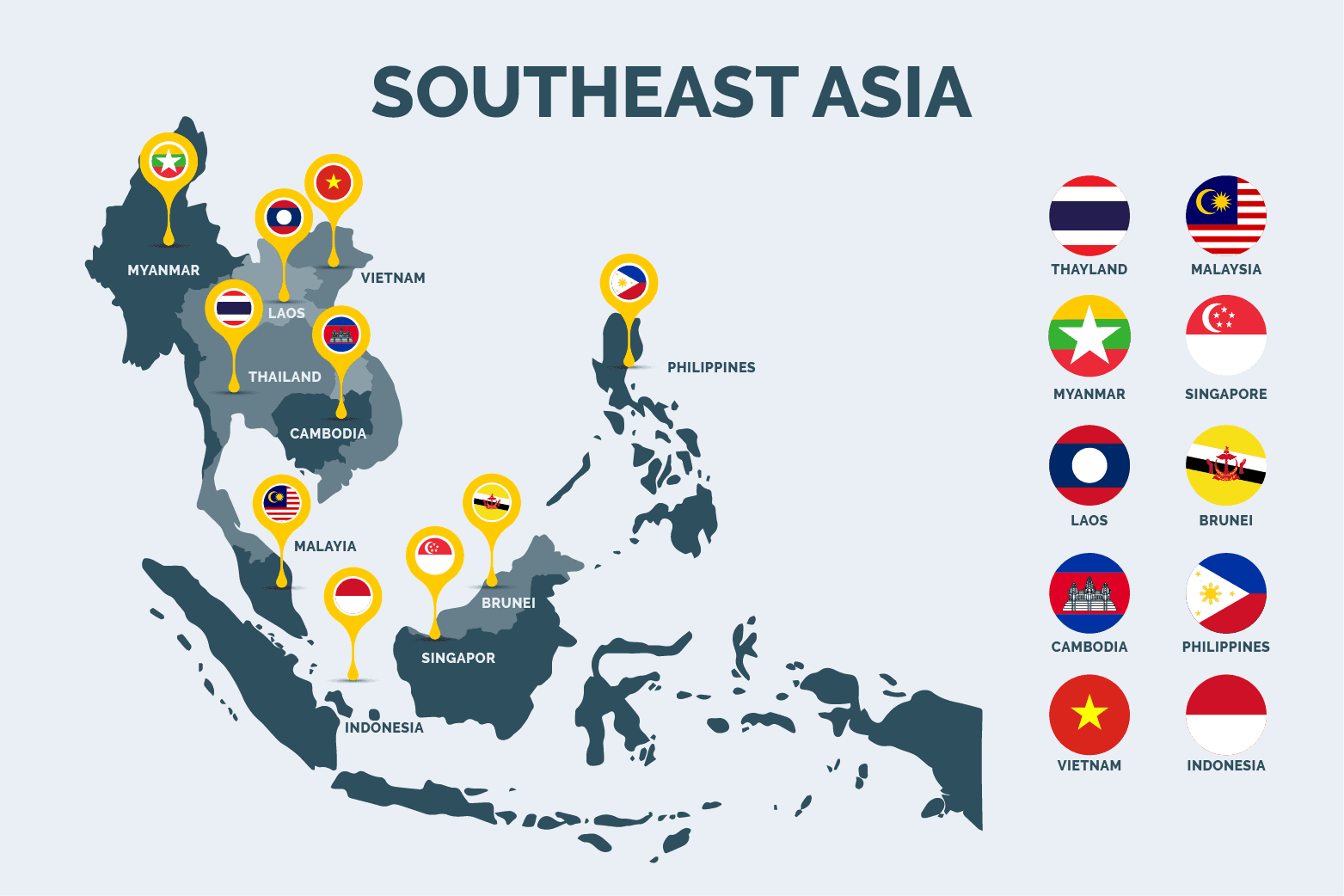
Southeast Asia's packaged food market is forecast to hit $162 billion by 2029, but the region's food supply chains are fracturing under export restrictions, Chinese import flooding, and Middle East-driven fertilizer disruption. Here's why certified, traceable Indian food exports are becoming the structural answer for buyers across Indonesia, Vietnam, Malaysia, the Philippines, and Singapore.
Southeast Asia is one of the fastest-growing food markets on the planet. Euromonitor has forecast Southeast Asia packaged food market retail sales to reach $162 billion by 2029, up from $111.9 billion in 2024 - a 45% increase in five years. Indonesia's economy expanded by 5.61% in Q1 2026, its fastest growth in more than three years, driven by strong household consumption. Vietnam's industrial output continues expanding. The Philippines, Malaysia, and Thailand are all posting consistent consumption growth. ASEAN's GDP growth is projected to average 4.4% between now and 2030.
Behind this growth story, however, lies a supply chain problem that is becoming more acute. Asian food supply chains are under documented pressure from multiple directions simultaneously - export restrictions from major suppliers, Chinese import flooding undercutting local producers, Middle East conflict disruption to fertilizer and energy inputs, and the structural reality that most Southeast Asian nations depend heavily on imports from a small number of origins for critical food categories. India's 2023 non-basmati white rice export restrictions caused immediate market disruption across the region, with buyers scrambling to alternative origins that could not fully replace Indian supply.
For Indian food exporters and the Southeast Asian importers who source from them, this moment represents an opportunity and a strategic imperative. The market is growing. The supply chain is fragile. And India is the best-positioned origin to provide the certified, traceable, price-competitive food products that Southeast Asian buyers increasingly need.
The Market | Five Countries That Matter Most
Indonesia is Southeast Asia's dominant food market by population - 280 million people, an expanding middle class, and household consumption accounting for over half of economic activity. Indonesia's Q1 2026 GDP growth of 5.61% was the fastest in more than three years. Inflation rose to 3.48% in the same period, with cost pressures from rupiah depreciation making imported raw materials more costly - a direct incentive to source efficiently. The Indonesian functional food market has already surpassed $250 million, with growth fueled by demand for immunity-boosting and weight-management products. For Indian spice and food exporters, Indonesia represents a high-volume market with strong demand for turmeric, cumin, coriander, and processed food formats that align with Indonesian culinary traditions.
Vietnam is the manufacturing powerhouse of Southeast Asia, with exports absorbing nearly half going to the United States. Vietnam's industrial output growth continued at 9.0% in Q1 2026. Its food processing sector - which requires consistent, certified ingredient inputs - is a growing demand channel for Indian spices and food ingredients used in ready-to-eat and convenience food manufacturing. Vietnam's middle class is expanding and increasingly demanding branded, quality-certified food products that domestic supply chains cannot fully supply at the quality levels required.
Malaysia is Southeast Asia's most sophisticated food market and a global hub for Halal food certification. With Malaysia's Halal food industry requiring certified-compliant inputs for its export-oriented production, India's Halal-certified food exports find natural demand in this market. Malaysia's NTUC FairPrice-equivalent modern retail chains have expanded their organic and premium food ranges significantly, creating shelf space for certified Indian food products at premium price points.
The Philippines is a major rice-importing nation with significant demand for basmati and fragrant rice varieties. India's 89% share of global basmati supply directly addresses Filipino premium rice demand. The Philippines imports Sanitary and Phytosanitary clearances from multiple agencies, but the documentation infrastructure for Indian food imports - FSSAI certification, phytosanitary certificates, certificates of analysis - provides the compliance foundation that Philippine import authorities require.
Singapore is the region's food logistics hub and one of the world's ten most food-resilient nations according to a new index published in 2026. Singapore's role as a regional transshipment and distribution center means that Indian food exports landing in Singapore can be efficiently redistributed across the broader ASEAN market. Singapore's highly developed modern retail, foodservice, and food manufacturing sectors all have demand for premium, certified Indian food products.
Why Southeast Asian Food Supply Chains Are Under Pressure
The ASEAN food import vulnerability that has emerged in 2025-2026 has several specific origins that create structural demand for reliable alternative supply from India.
India's own 2023 rice export restrictions created a regional shock. In July 2023, India restricted exports of non-basmati white rice - which accounts for roughly 40% of global rice trade by volume. Later measures extended to broken rice and sugar. For Southeast Asian buyers, the impact was immediate: buyers shifted to Vietnam and Thailand, prices rose across regional markets, and freight routes adjusted almost overnight. The episode demonstrated how dependent Southeast Asian buyers were on Indian supply and how limited the alternatives were when India restricted exports.
Chinese goods are flooding Southeast Asian markets. Imports of Chinese consumer goods by Southeast Asian nations increased approximately 70% between 2017 and 2023. Indonesia's textile industry lost hundreds of factories. Thailand's government reports 2,000 factories closed in 2023 partly due to Chinese import competition. As Chinese manufacturers redirected supply from the US following tariff escalation, Southeast Asian markets absorbed the overflow - creating deflationary pressure on domestic producers while simultaneously increasing demand for certified, traceable food products that Chinese imports typically cannot provide at the quality standards required.
Middle East conflict disrupted fertilizer supply. Around 1.3 million tonnes of fertilizers per month cannot transit the Strait of Hormuz when it is closed. The Gulf accounts for 30 to 35% of global urea exports. UNCTAD's May 2026 report specifically named Indonesia, Vietnam, Philippines, Thailand, and Bangladesh among the countries that introduced emergency measures to manage rising fuel and food costs from the Hormuz disruption. Rising fertilizer input costs are feeding through to agricultural production costs in Southeast Asia, adding further pressure on food supply chains.
Food processing growth requires certified imported inputs. Southeast Asia's food processing sector is expanding. Cloud kitchen investment is growing. E-grocery penetration in Southeast Asia is forecast to triple to 3-5% by 2026, lifting the regional market value to nearly $17 billion. These modern food channels require certified, specification-compliant ingredients - exactly the products that India's FSSAI-certified, laboratory-tested export infrastructure is best positioned to supply.
What India Can Supply That Southeast Asian Markets Need
Spices for food manufacturing. The demand for spices as food processing inputs - across curry pastes, instant noodles, ready-to-eat meals, and snack seasonings - is growing as Southeast Asia's packaged food sector expands. India is the world's dominant supplier of turmeric, cumin, coriander, chili, pepper, and cardamom. Food manufacturers in Indonesia, Vietnam, and Malaysia sourcing these spice inputs from India get the benefit of India's production depth, competitive pricing, and established export documentation.
Basmati and premium rice. Basmati rice demand in Southeast Asia is driven by South Asian diaspora communities (particularly significant in Malaysia and Singapore), premium restaurant and hospitality channels, and growing mainstream consumer interest in fragrant long-grain varieties. India's 89% share of global basmati supply makes it the only commercially viable origin for this category.
Lentils and plant-based proteins. Southeast Asia's growing middle class is increasingly interested in plant-based protein - a global trend that the McKinsey Q1 2026 Southeast Asia review confirmed is visible in Indonesian, Vietnamese, and Thai consumer markets. India's range of lentils, chickpeas, and other pulses provides the primary global supply source for the plant-protein ingredients that Southeast Asian food manufacturers are increasingly incorporating into their product ranges.
Organic and certified products. Singapore, Malaysia, and increasingly Vietnam have growing organic retail segments. India's NPOP certification - mutually recognized by the EU - provides the traceability documentation that premium retail buyers in these markets require. For Indian exporters supplying Southeast Asian premium channels, organic certification is increasingly a requirement rather than an option.
The Regulatory Landscape | What Southeast Asian Buyers Need from Indian Suppliers
The Southeast Asia food import regulations framework is more fragmented than the EU or US - each country has its own food safety agency, import licensing process, and labeling requirements. But the common thread is that certified, well-documented Indian exporters navigate these frameworks more easily than suppliers without established documentation infrastructure.
Indonesia requires BPOM (Badan Pengawas Obat dan Makanan) registration for food products, which is Indonesia's food and drug authority. Processing typically takes 8 to 16 weeks. All food labels must be in Bahasa Indonesia. Halal certification from MUI (Majelis Ulama Indonesia) is commercially essential for mass market distribution in the world's largest Muslim-majority country.
Vietnam moved from mandatory pre-registration to a self-announcement system for many food categories, but still requires HACCP or GMP certification from the exporting facility. Vietnamese labeling requirements mandate Vietnamese language text for retail products.
Malaysia requires BKKM (Bahagian Keselamatan dan Kualiti Makanan) compliance and - for products targeting Halal channels - JAKIM Halal certification or recognition of equivalent Halal certification from approved foreign bodies. India's FSSAI-approved Halal certifiers are recognized in Malaysia.
Philippines requires Sanitary and Phytosanitary Import Clearances from the Bureau of Plant Industry or Bureau of Animal Industry, plus FDA registration for processed foods. Transit times and documentation requirements are well-established for Indian-origin agricultural products.
Singapore has one of the region's most efficient food import frameworks, administered by the Singapore Food Agency (SFA). Documentation requirements focus on safety and labeling compliance. Singapore's role as a regional hub means that products cleared through SFA can often be redistributed across ASEAN with appropriate documentation.
For all markets, the baseline Indian exporter documentation - FSSAI certification, APEDA registration, phytosanitary certificate, certificate of analysis - provides the foundation that local customs and food safety authorities build their assessment on. Halal certification is the additional credential that unlocks the majority of ASEAN distribution channels, given the region's large Muslim consumer population.
Why Now Is the Right Time to Build India-Southeast Asia Supply Relationships
The convergence of three factors makes 2026 the right moment to build Indian food supply partnerships for Southeast Asia.
The market is growing. $162 billion by 2029 in packaged food retail sales, 4.4% average GDP growth across ASEAN, and rapid e-grocery and food processing sector expansion are all generating demand for certified food imports at a rate that domestic production cannot keep pace with.
Supply chain fragility is creating urgency. The 2023 rice export restriction episode, the 2026 fertilizer disruption from the Hormuz crisis, and the ongoing pressure from Chinese import flooding have made Southeast Asian buyers acutely aware of their supply chain vulnerabilities. The buyers actively seeking to diversify away from single-origin dependence are the most receptive to building structured supply partnerships.
India's trade and export infrastructure is at its strongest. Record agricultural export volumes, FSSAI and APEDA documentation infrastructure, Halal certification frameworks, and the India-ASEAN Free Trade Agreement (in force since 2010 and progressively improving) together create the most favorable conditions for Indian food exports to Southeast Asia that have ever existed.
At Bayharbor Exports, we supply the complete range of Indian food products for Southeast Asian importers - basmati rice, spices, lentils, pulses, processed foods, and Halal-certified variants - with full FSSAI certification, APEDA registration, Halal certification, and third-party laboratory certificates of analysis as standard. We understand the documentation requirements for Indonesia's BPOM process, Malaysia's JAKIM Halal framework, and Singapore's SFA compliance system.