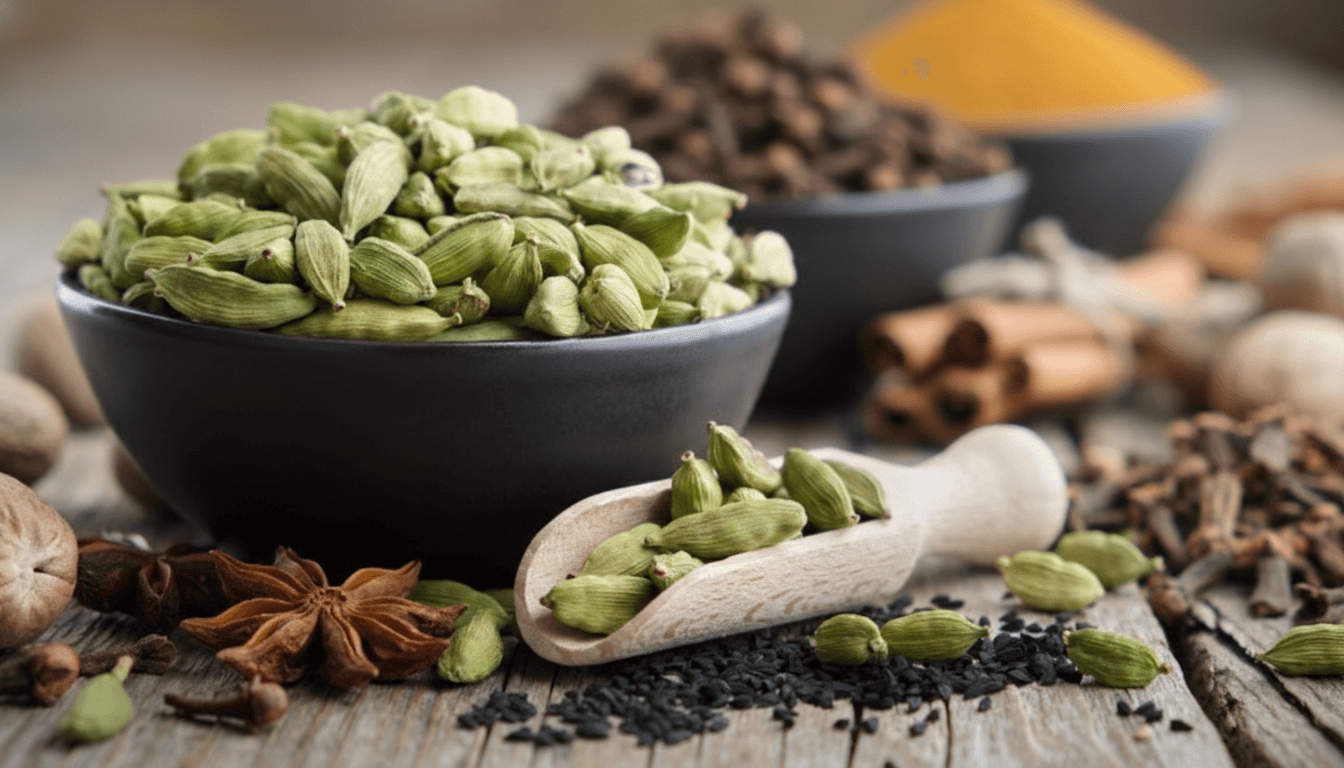
Cardamom is the world's third most expensive spice and demand is accelerating. Here's what serious spice buyers need to know about the global market in 2025.
The Cardamom Boom: A $1.5 Billion Market Hiding in Plain Sight
Most people have tasted cardamom without ever thinking about it.It's the warmthin a good chai, the aromatic lift in Scandinavian pastries, the backbone of Arabic gahwa. Cardamom has been quietly present in global food culture for centuries and yet, as a commodity, it gets a fraction of the attention given to black pepper or turmeric, despite being the world's third most expensive spice after saffron and vanilla.
That oversight is becoming harder to justify. The global cardamom market was valued at approximately $1.5 billion in 2024 and is on track to reach $2.4 billion by 2032, growing at a steady 5.2% annually. In 2025 specifically, a dramatic supply disruption in Guatemala historically the world's largest cardamom producer has completely reshuffled the global sourcing map and created one of the most significant buying opportunities for Indian cardamom in years. For importers, food manufacturers, and procurement professionals who aren't paying close attention, this market is moving fast.
Why Cardamom Commands a Premium
Before getting into the supply dynamics, it's worth understanding why cardamom sits in a different commercial category from most spices.
Cardamom plants take three years from planting before they produce their first harvest and remain productive for only five to six years. They grow exclusively in humid tropical climates Kerala's Western Ghats in India, the highlands of Guatemala, and parts of Sri Lanka. The harvesting process is entirely manual; the pods are picked by hand, one by one, because they ripen at different rates on the same plant. A single kilogram of quality green cardamom requires an enormous amount of labor.
The result is a spice where supply is structurally constrained, where quality varies significantly by origin and growing conditions, and where cardamom price swings of 30 to 40% in a single season are not unusual. This isn't a commodity you manage the same way as cumin or coriander. It requires a sourcing relationship built on reliability, quality consistency, and realistic lead time planning which is precisely what separates experienced spice importers from those who get caught short.
The Guatemala Shock and What It Means for Buyers
The dominant story in global cardamom supply in 2025 is Guatemala. Historically, Guatemala was the world's largest cardamom producer, accounting for roughly 40,000 to 50,000 metric tons in strong years and dominating exports to the Middle East on price. That has changed dramatically.
Guatemala's cardamom production in 2025 is estimated at just 17,000 metric tons, a collapse of 44% compared to normal years. A prolonged drought followed by insufficient replanting has left global supply dramatically tighter than it was 18 months ago. What's more, the lack of large-scale replanting means that Guatemalan production is expected to remain suppressed at around 22,000 metric tons in 2026 as well. This isn't a one-season disruption. The recovery timeline runs at least two to three years.
For buyers who relied primarily on Guatemalan cardamom for price reasons, the calculus has completely changed. Indian green cardamom is now trading at around $35 per kilogram internationally, and with Guatemala's cheaper supply largely absent from the market, the arbitrage that historically kept Guatemalan cardamom competitive has narrowed significantly. Indian exporters are now receiving inquiry volumes they haven't seen in years, with buyers from Saudi Arabia, UAE, and Kuwait actively sourcing from Indian auction centers to fill the gap.
The critical number for procurement teams to understand: India cardamom exports rose 37.6% year-on-year in April through July 2025 alone. That's not a coincidence it's the direct consequence of buyers pivoting to Indian supply as Guatemala's production collapsed.
India's Position Varieties, Quality, and the Supply Reality
India is the world's second-largest cardamom producer, with approximately 20,000 metric tons of annual production, primarily from Kerala's Idukki district, which accounts for around 60% of national output. Karnataka and Tamil Nadu make up the balance.
What cardamom from India offers that Guatemalan cardamom doesn't is a quality differential that matters enormously to certain markets. Indian green cardamom particularly the Alleppey Green and Coorg Green varieties has a higher essential oil content, a more intense aroma, and a flavor profile that premium buyers have long preferred for applications where the spice's character is the point. In Ayurvedic products, high-end confectionery, specialty beverages, and pharmaceutical extracts, Indian origin is simply preferred.
India also produces a variety that Guatemala doesn't: black cardamom, grown primarily in Sikkim and parts of Northeast India. Black cardamom has a smoky, camphor-like profile entirely different from green cardamom and is used in specific savory applications, certain spice blends, smoked meat preparations, and traditional medicinal products. It occupies a niche but growing segment, particularly among importers serving premium ethnic food markets in Europe and North America.
Supply isn't unlimited, however. The Spices Board of India estimates 2024-25 production at approximately 20,696 metric tons down 18% year-on-year due to fungal outbreaks that reduced yields in affected growing areas. The combination of lower Guatemalan production and softer Indian yields in 2024-25 is exactly what has driven the current price environment. Buyers waiting for prices to fall are likely waiting for a correction that the supply fundamentals don't currently support.
Where Demand Is Growing And Why?
The Middle East is and has long been the anchor of cardamom import demand globally. Saudi Arabia is the world's single largest importer, followed closely by Kuwait and UAE. The cultural centrality of cardamom in the region gahwa, the spiced Arabic coffee prepared with green cardamom, is served at virtually every formal gathering across the Gulf means demand here is structural, not discretionary. It peaks sharply around Ramadan and Eid, and GCC spice buyers who get caught without sufficient stock heading into those periods face real commercial consequences.
Europe tells a different but equally important growth story. Germany, the UK, and the Netherlands are the primary cardamom importers in Europe, and the trend driving demand is premiumization. Organic cardamom now commands a 15 to 20% premium in European retail channels. Scandinavian baking traditions where cardamom is a defining ingredient in Danish pastries and Finnish coffee bread are experiencing a meaningful revival as consumers move toward artisan food experiences. And the clean-label movement in functional beverages and wellness supplements has opened an entirely new demand channel: cardamom extracts and powders in teas, health drinks, and nutraceuticals.
North America is the fastest-growing region by percentage, with a 19.3% share of the green cardamom market in 2025 and accelerating demand driven by the growth of South Asian and Middle Eastern diaspora communities, the mainstream adoption of chai and ethnic cuisines, and the specialty coffee industry's embrace of cardamom as a premium ingredient. The US and Canada have well-developed import infrastructure for Indian spices and are natural growth markets for suppliers who can consistently meet FDA and CFIA quality requirements.
The Organic and Sustainability Premium
One development that serious buyers shouldn't overlook is the growing bifurcation between conventional and organic cardamom markets. In Europe particularly, retailers are imposing pesticide residue limits well below global norms, effectively making organic or residue-free certification a functional requirement for premium shelf placement.
Organic cardamom from India carries a higher price, but for the right buyer, it opens access to retail channels and margin structures that conventional cardamom simply can't reach. The organic spice import segment is growing at 7% annually faster than the overall market and supply of genuinely certified organic cardamom from Indian producers remains limited relative to demand. Importers building long-term relationships with certified organic Indian suppliers now are securing a position that will be harder to replicate in three to five years.
Sustainability traceability is an adjacent requirement gaining momentum. An estimated 44% of cardamom exporters had adopted blockchain traceability systems by 2025. For buyers serving European retail or premium foodservice channels, the ability to trace cardamom to a named estate or cooperative is transitioning from a differentiating feature to a baseline requirement.
Practical Realities for Procurement Teams
For buyers evaluating cardamom sourcing from India, a few practical realities shape the decision.
Auction-based pricing at Indian cardamom centers creates short-term price volatility that can make forward contracting tricky. Working with a supplier who has consistent auction access and the financial capacity to absorb short-term price movements is more valuable than chasing the lowest spot price on any given day.
Quality grading matters more in cardamom than most spices. The 7mm, 7.5mm, and 8mm cardamom size grades carry meaningfully different price points, and the distinction between Alleppey Green and other origin varieties affects application suitability. Clarity on specification at the point of purchase and a supplier who genuinely understands those specifications saves significant downstream problems.
The regulatory environment is also improving for buyers. The India-EU FTA signed in January 2026 is expected to reduce tariffs on Indian cardamom for European buyers over its implementation timeline. If you're a European importer, the landed cost arithmetic on Indian-origin products is actively getting better. Our complete guide for European importers on the India-EU FTA covers the framework in detail.
What This Means for Your Sourcing Strategy
The cardamom market in 2025 is not operating under normal conditions. Supply is tight, Guatemala's recovery is years away, and demand from the Middle East, Europe, and North America continues to grow. Buyers who treat this as a background market they'll sort out when needed are the ones who end up scrambling for supply at peak-season prices.
India is the quality leader in green cardamom export. With Indian spice exporters now fielding the highest inquiry volumes in years, the supply window for forward contracting at sensible prices is open but it won't stay that way indefinitely. The buyers who establish or strengthen their Indian cardamom sourcing relationships now are the ones who will have the supply certainty their competitors won't when the market tightens further.
At Bayharbor Exports, we supply green cardamom across standard grades and size specifications, with FSSAI certification as standard and organic cardamom certification available for buyers who require it. We source from Kerala, the heart of Indian cardamom country and have established relationships with growers and auction participants that give us consistent access to quality supply even when the broader market is under pressure.
Ready to build your cardamom supply chain from India? Reach out to Bayharbor Exports to discuss grades, availability, certifications, and pricing for your market.