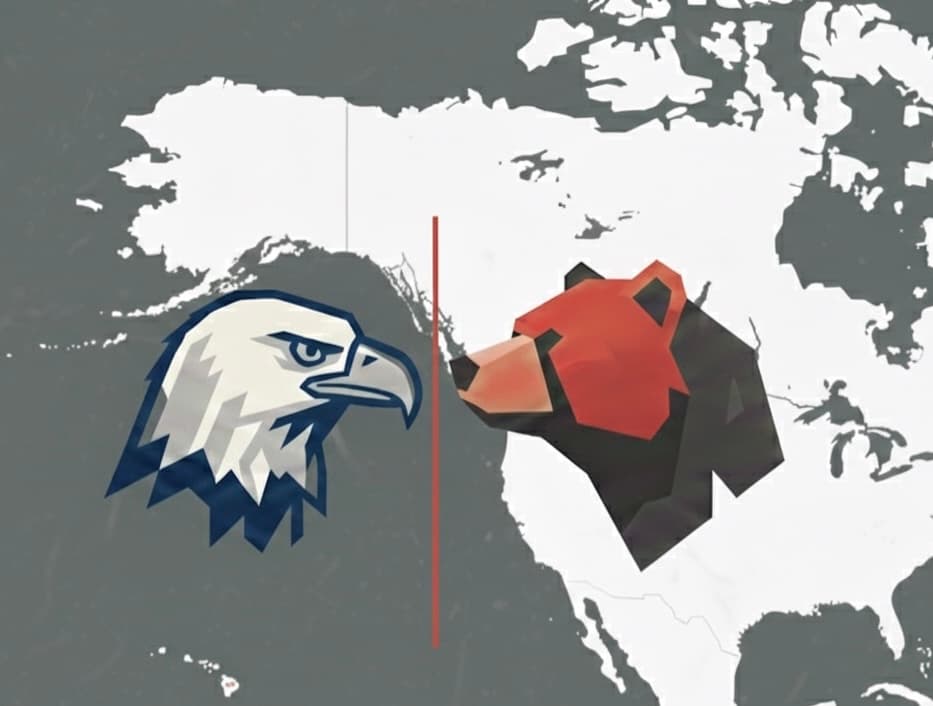
The US-Canada trade war has fractured a $72B food partnership, sending costs soaring. Here's why smart importers on both sides are pivoting to Indian suppliers.
The US-Canada Trade War: Why Importers Are Turning to India
When President Trump imposed 25% tariffs on Canadian imports on February 1, 2025, he didn't just start a political dispute between two neighbors, he fractured one of the world's most deeply integrated food supply chains. Within weeks, Canada hit back with 25% retaliatory tariffs on CA$30 billion worth of American goods. By March 2025, over $5.5 billion worth of US agricultural products were subject to Canadian counter-tariffs, and food prices on both sides of the border were already climbing.
For importers, distributors, and procurement professionals caught in the crossfire, 2025 has been a year of painful recalibration. The disruption is real, the costs are measurable, and the political uncertainty shows no sign of resolving. But embedded in this disruption is a clear signal for forward-thinking buyers: supply chains that rely on a single trade corridor are a liability. And for those willing to diversify, India has quietly become the most compelling alternative in global food sourcing.
A $72 Billion Partnership Under Pressure
The scale of what has been disrupted is remarkable. In 2023, bilateral agri-food trade between the US and Canada reached US$72.6 billion one of the most integrated food partnerships anywhere on the planet. This wasn't just countries trading finished goods. A single hamburger might include Canadian beef, raised partly in the US, processed in Ontario, and served back to consumers in both countries. The integration ran that deep.
That model is now under severe strain. The US imposed a 25% tariff on most Canadian goods and 10% on Canadian energy. Canada's retaliation targeted $30 billion in US goods in its first tranche alone, escalating to a list covering an additional $86 billion including dairy, eggs, honey, meat, and a wide range of processed foods. In 2024, Canada was the second-largest destination for US agricultural exports, valued at $28.4 billion. That market relationship is now structurally damaged.
The human cost is visible in the numbers. Canadian fed cattle prices plummeted by more than 22%, with estimated revenue losses reaching C$4 billion. Beef and pork exports from Canada to the US dropped meaningfully in early 2025 compared to 2024. Canadian farmers began reconsidering which crops to plant, weighing canola normally a $5 billion export to the US against crops better suited for non-US markets. And Canadian grocery store food prices rose 3.8% in April 2025, nearly double overall inflation of 1.7%, as tariff costs flowed through supply chains directly to consumers.
American importers have not escaped unscathed. US dairy exporters, who relied on Canada as their second-largest agricultural market, found themselves subject to 25% counter-tariffs overnight. American food processors sourcing Canadian inputs canola derivatives, certain grains, and cross-border livestock saw input costs rise. And the broader uncertainty has made long-term supplier contracting extremely difficult on both sides of the border.
The Problem Isn't Just Tariffs : It's the Uncertainty
What makes this trade war uniquely disruptive for procurement teams isn't just the tariff rates themselves. It's the unpredictability. Within the first few months of 2025 alone, the US announced tariffs, paused them for 30 days, reimposed them, doubled steel and aluminum tariffs to 50%, threatened to increase Canadian tariffs to 35%, partially walked back some measures, and then introduced a new wave of tariffs in April on top of the original ones.
Canada's response has been firm and sustained. Prime Minister Mark Carney has maintained Canada's retaliatory posture, characterizing the tariff war as an economic attack on Canadian workers and families, and signaling no willingness to back down without credible, lasting commitments from Washington. The October 2025 US Senate vote to nullify the Canadian tariffs passed 50-46 but was subsequently blocked, keeping the political standoff firmly in place.
For procurement managers, this sustained uncertainty is arguably more damaging than any fixed tariff rate. A 25% tariff can be modeled into pricing. A trade policy that can shift based on a social media post going from pause to escalation and back within weeks cannot. Companies that spent 2024 optimizing costs are spending 2025 managing risk, and they are paying for it.
Why India Has Emerged as the Alternative
Against this backdrop, a growing number of American and Canadian importers are looking seriously at India as a sourcing partner and finding that the case is stronger than they may have expected.
India does not have a trade war with the United States. It does not have one with Canada. For American buyers, the February 2026 US-India trade deal has actively reduced tariffs on Indian goods from 50% down to 18%, making Indian products more price-competitive than they have been in years. For Canadian buyers, the diplomatic tensions that characterized the India-Canada relationship in 2023-2024 have been on a clear reset path, with Prime Minister Carney's India visit and CEPA negotiations in early 2026 signaling institutional commitment to a stronger trade relationship.
What India offers isn't just political stability, it's genuine product breadth. India is the world's largest exporter of basmati rice and produces 80% of the world's turmeric. It is the dominant global player in spices including cumin, coriander, cardamom, and black pepper. It is one of the world's largest producers and exporters of lentils and pulses red lentils, yellow lentils, chickpeas, and a wide range of others. These are not niche categories. They are high-demand commodities with consistent global markets, and in many cases, India's production volumes are so dominant that there is no meaningful alternative source at scale.
For US and Canadian importers, this matters in two specific ways. First, these are products that both countries consume in significant and growing quantities like basmati rice alone accounts for over 60% of US aromatic rice imports, and lentils and spices are embedded in the food supply chains of both countries' ethnic food sectors, restaurant industries, and mainstream retail. Second, they are products that neither the US nor Canada produces domestically at any meaningful scale. India isn't competing with a domestic supplier; it's filling a genuine gap.
What the Pivot to Indian Sourcing Looks Like in Practice
Importers new to Indian sourcing often assume it carries greater complexity than established North American channels. In reality, India's agricultural export infrastructure is far more developed than this assumption suggests.
Reputable Indian exporters operate under FSSAI certification India's equivalent of FDA or CFIA approval and are experienced in meeting US FDA and Canadian CFIA documentation requirements. Phytosanitary certificates, quality testing, residue analysis, and certificates of origin are standard parts of the export process, not optional extras. Halal certification is widely available, as is organic certification for relevant product lines.
Logistics from India to North America via sea freight typically runs 18 to 28 days depending on routing and port pairing comparable to or better than some domestic cross-continental movements. For urgent orders or smaller volume requirements, air freight options exist. Most professional exporters work at container-level volumes — 20-foot or 40-foot containers which represent practical minimums for distributors and larger retailers.
Canadian lentil importers may find the India relationship particularly natural. Canada itself is a major lentil producer, and Indian and Canadian lentils compete in many global markets meaning Indian supply chains are already calibrated to international standards that Canadian buyers recognize. For spices, basmati rice, and processed foods, the supply chain is well-established and well-understood by trade professionals on both sides.
Building Supply Chain Resilience Beyond This Trade War
The US-Canada tariff dispute has reinforced a lesson that global supply chain managers should carry forward permanently: concentration in a single trade relationship is a structural risk. The USMCA corridor, which looked like the gold standard of integrated food trade as recently as 2024, has proven vulnerable to political disruption on a timescale that procurement teams could not plan for.
The solution isn't to abandon North American supply chains. It's to build alongside them. An importer who sources spices, basmati rice, and lentils from India while maintaining North American suppliers for appropriate commodity categories has built a portfolio that can absorb future shocks — whether those shocks come from tariffs, weather, logistics crises, or geopolitical friction.
India's advantages in this context are structural rather than cyclical. Democratic governance, consistent rule of law, strong English-language capability across its trade and business communities, year-round agricultural productivity across diverse climate zones, and an active government program of investment in export infrastructure and market access agreements — these are not short-term factors. They represent a durable foundation for long-term sourcing partnerships.
The Bottom Line
The US-Canada trade war has exposed the fragility of supply chains built on the assumption that political relationships between neighbors are permanent. A $72 billion bilateral food partnership has been fractured by tariffs, retaliation, and sustained political uncertainty - and there is no clear timeline for resolution.
For importers on both sides of the border, the lesson is the same: diversification is not optional. India offers the product range, quality infrastructure, certifications, and political stability to serve as a genuine long-term sourcing partner for North American buyers. The companies building those relationships now are the ones that will be best positioned when the next disruption whatever its source arrives.
Ready to explore Indian sourcing for your supply chain?
Contact Bayharbor Exports to discuss product availability, pricing, and how we can support your sourcing needs.