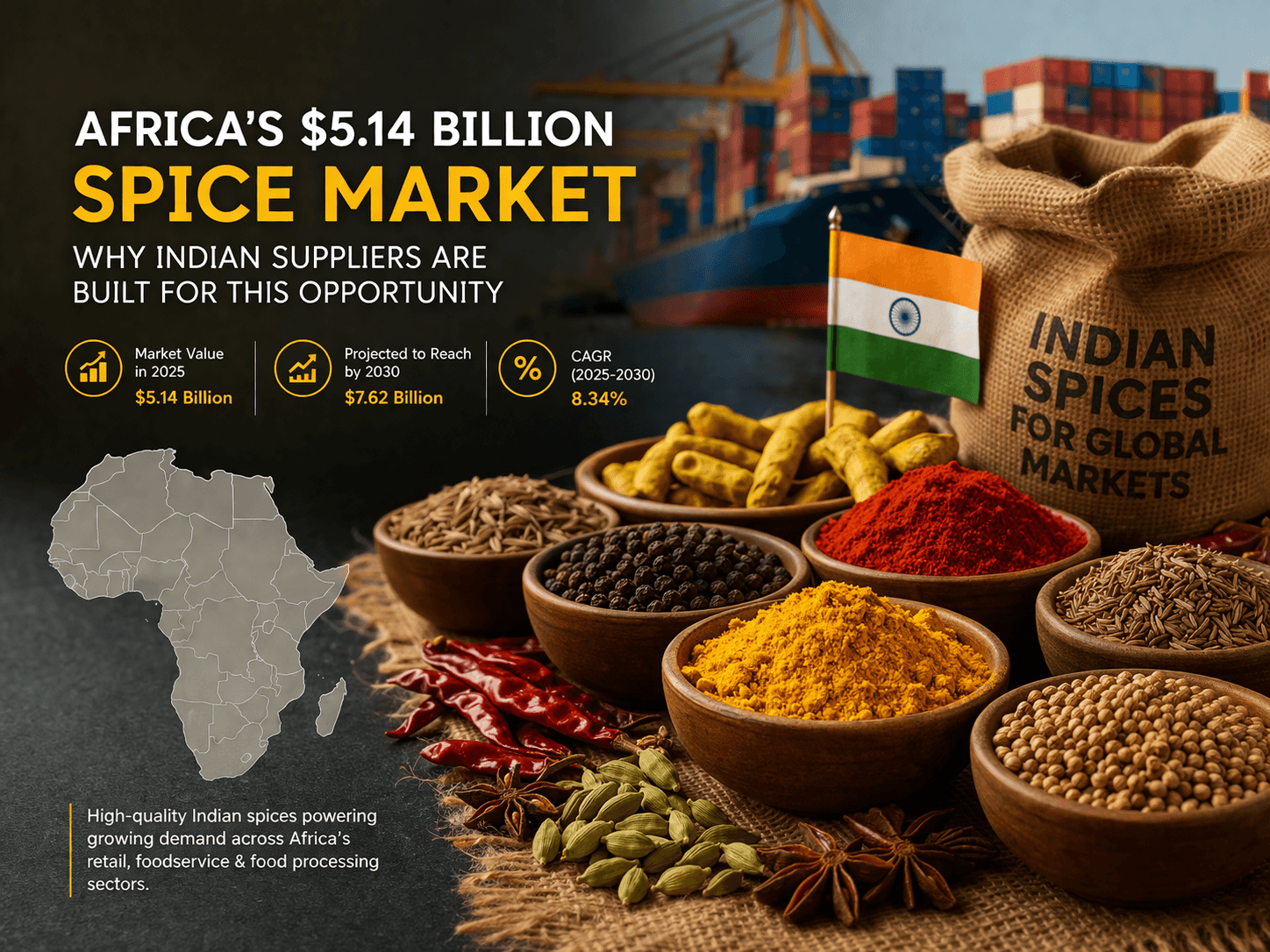
Africa’s spice and seasoning market is rapidly expanding, creating a major opportunity for Indian suppliers to meet rising demand across urban, premium, and industrial food sectors.
Africa's $5.14 Billion Spice Market: Why Indian Suppliers Are Built for This Opportunity
Africa is one of the fastest-growing spice markets on the planet right now, and most of the global trade intelligence industry has only just caught up to that fact. The African spice and seasoning market was valued at $5.14 billion in 2025 and is forecast to reach $7.62 billion by 2030 - a CAGR of 8.34% that exceeds growth rates in Europe, North America, and most of Asia. Rapid urbanization, an expanding middle class, the growth of packaged and branded food formats, and deep-rooted culinary traditions that put spices at the center of everyday cooking are converging to create one of the most structurally attractive import markets in the world for high-quality, certified Indian spices.
For African food importers and distributors who source from India, this is the moment to understand the market clearly - which categories are growing fastest, which African economies are leading demand, and what quality and certification standards are increasingly required to compete in the organized retail, foodservice, and food processing channels that are driving the market forward.
The Market Structure | Four Demand Engines Driving Growth
Africa's spice market is not a single, uniform market. It is a continent of 54 countries and over 1.4 billion consumers, with distinct regional palate profiles, infrastructure realities, and retail channel structures. But across the diversity, four demand engines are driving consistent growth that Indian spice exporters are exceptionally well-positioned to serve.
Rapid Urbanization and the Convenience Shift
Africa continues to experience some of the world's fastest urbanization rates in 2026, with millions transitioning from rural lifestyles to metropolitan centers. This shift is fundamentally altering food consumption patterns. Busy urban professionals and dual-income households now face time constraints that are pushing demand toward pre-mixed seasoning blends, spice cubes, bottled spice pastes, and ready-to-use cooking formats. The African packaged spice demand is being driven not by a rejection of traditional flavors but by a desire to access those flavors faster and more conveniently. For Indian exporters supplying bulk ground spices and standardized spice blends to African food manufacturers and packagers, this trend creates volume demand that will grow consistently through the decade.
Middle Class Expansion and Premiumization
The growth of Africa's middle class has directly increased disposable incomes across major urban centers - particularly in South Africa, Nigeria, Kenya, and Egypt. Higher income consumers are seeking branded, quality-certified, and organically positioned spice products. The shift toward "clean-label" and functional spice products is particularly visible in South Africa, where the organic market has been growing strongly, and in Egypt and Nigeria, where packaged spice brands are gaining shelf space at the expense of loose, unbranded products. This premiumization trend benefits Indian exporters who supply certified, tested, traceable spices - because these are exactly the products that win space in modern retail formats.
Food Processing Sector Growth
Africa's food processing industry is expanding at pace. Major multinational flavor houses including McCormick, Kerry Group, and Givaudan are investing in regional production and technical expertise centers across the continent. Kerry Group's April 2025 inauguration of its first taste manufacturing facility in Rwanda is a landmark signal. These processors require consistent, large-volume, specification-compliant spice inputs - and India is the natural primary origin for the categories they use most: turmeric, cumin, chili, pepper, coriander, and cardamom. As Africa's food processing capacity expands, the demand for industrial-grade Indian spice imports for Africa will grow in parallel.
Traditional Culinary Culture
Africa's own spice culture is rich, deep, and deeply embedded in daily life. Berbere, Ras el Hanout, Peri-Peri, Chakalaka, and Mitmita are among the traditional African spice blends that are experiencing growing consumer interest - not just domestically but internationally, as Spices Inc.'s 2025 Flavor Report identified African spice blends as a leading global trend. This cultural richness creates demand for both indigenous spice production and imported spice inputs that blenders and food manufacturers use as base ingredients for traditional recipes at scale.
The Key Markets | Where the Demand Concentrates
While the African spice opportunity spans the continent, five markets warrant priority attention from Indian exporters and the African importers who source from them.
Nigeria is Africa's most populous country and one of its largest food markets. The country's large and growing urban middle class, its well-established commodity trading sector, and its deep cultural use of spices in everyday cooking make it a high-volume opportunity for Indian chili, turmeric, coriander, and pepper exports. Lagos and Apapa port are the primary entry points. Transit times from Indian ports run 30 to 45 days, typically with transshipment at intermediate hubs. NAFDAC (National Agency for Food and Drug Administration and Control) approval is mandatory for all food products entering the Nigerian market, and the process takes 8 to 12 weeks for new product registrations - a lead time that importers must factor into planning cycles.
Kenya is East Africa's logistics hub and a gateway to the broader East African Community. Mombasa port receives Indian-origin cargo in 12 to 18 days from Mumbai or Mundra - the fastest transit time on any African route. Kenya's growing formal retail sector, its large South Asian diaspora community, and its role as a regional distribution hub for Uganda, Tanzania, and Rwanda make it a priority market for Indian spice importers. The Kenya Bureau of Standards (KEBS) administers food import compliance, requiring pre-export conformity verification for food products.
South Africa is Africa's most developed and regulation-intensive food market. The South African Bureau of Standards (SABS) and the Department of Agriculture, Land Reform and Rural Development (DALRRD) jointly administer food import requirements. South Africa's modern retail chains - Pick n Pay, Checkers, Woolworths, SPAR - have extensive private label spice ranges and sophisticated quality requirements. SPAR Group South Africa's digital delivery platform recorded a 174% increase in food and grocery delivery volumes in the first half of 2025, signaling growing organized retail penetration that benefits well-documented, certified Indian spice suppliers.
Egypt is North Africa's dominant food market and a major transit hub for the broader Arab world. Egypt's large population, its food processing sector, and its established import infrastructure through Alexandria port make it one of India's most significant African trading partners for spices. Egypt's GOEIC (General Organization for Export and Import Control) administers food import licensing. Indian-origin spices have strong market penetration in Egypt, particularly cumin, coriander, and fenugreek.
Ghana is West Africa's most stable and rapidly modernizing food market. Tema port serves as Ghana's primary import gateway and a regional transshipment hub for Francophone West Africa. Ghana's Standards Authority (GSA) administers food safety compliance. The country's growing middle class, expanding quick-service restaurant sector, and increasing retail modernization make it a compelling market for quality-certified Indian spices entering West Africa.
Why India Is Africa's Most Natural Spice Supplier
The alignment between what Africa's spice market needs and what India produces is more complete than with any other origin country in the world.
India supplies approximately 45% of global spice trade volume. It is the world's dominant producer of chili, turmeric, cumin, coriander, cardamom, fenugreek, and pepper - precisely the categories that form the foundation of African cooking across every regional tradition. India's production depth means that African importers can source their entire spice range from a single origin, simplifying supplier relationships, logistics, and documentation management.
India's price competitiveness is structural rather than cyclical. Its agricultural land base, labor costs, and production scale create a cost advantage on bulk spice supply that competing origins cannot match. For African food manufacturers and blenders operating in price-sensitive consumer environments, this cost competitiveness is a commercial necessity.
Indian spice export volumes to Africa have been growing consistently, with Dubai-based traders - who import bulk Indian spices, value-add through packaging, and re-export to Africa - serving as an indicator of the scale of underlying India-Africa spice trade. As African importers build direct sourcing relationships with Indian exporters rather than routing through intermediaries, the economics improve further and traceability documentation becomes cleaner.
India's export infrastructure for the African market is established and improving. Direct shipping from Mundra and Nhava Sheva to Mombasa, Durban, Apapa, Tema, and Alexandria is available through major carriers. Transit times range from 12 days to East Africa to 30 to 45 days to West Africa. The introduction of more direct India-Africa shipping services as bilateral trade volumes grow will continue to improve the logistics picture over the coming years.
The Certification Landscape for African Buyers
African food import markets are becoming more regulation-intensive, and the certification requirements that African buyers must communicate to their Indian suppliers are evolving.
At baseline, every Indian spice supplier for the African market should hold FSSAI certification and APEDA registration, carry a valid Import Export Code (IEC), and supply a phytosanitary certificate and certificate of analysis with every shipment. These are non-negotiable minimum credentials.
For buyers supplying modern retail chains or food manufacturers in South Africa, Kenya, or Nigeria, ISO 22000 or BRC food safety certification from the Indian supplier is increasingly expected. For organic-positioned products targeting South Africa's growing premium retail segment, NPOP certification from India - which is mutually recognized by the EU - provides the traceability documentation that organized retailers require. For buyers importing into Nigeria, NAFDAC pre-registration of the specific product and exporter is a mandatory step before the first shipment. This takes time but only needs to be done once per product-exporter combination. Working with an Indian exporter who has prior NAFDAC registration experience, or is willing to support the registration process with the required documentation, significantly reduces the time-to-market on new product introductions.
Why Bayharbor Exports
At Bayharbor Exports, we supply the full range of Indian spices for African importers - turmeric, cumin, coriander, chili, black pepper, cardamom, fenugreek, and spice blends - backed by FSSAI certification, APEDA registration, third-party laboratory certificates of analysis, and phytosanitary certificates as standard. We understand the documentation requirements for key African markets including Nigeria's NAFDAC process, Kenya's KEBS requirements, and South Africa's DALRRD import framework.
We ship through Mundra and Nhava Sheva with established freight relationships on India-to-Africa routes. Our complete guide on FCL vs LCL shipping for India imports covers the logistics decision in detail for African buyers managing volume and frequency planning.
If you are building or scaling your Indian spice supply chain for the African market, reach out to Bayharbor Exports to discuss product availability, pricing, and documentation support.