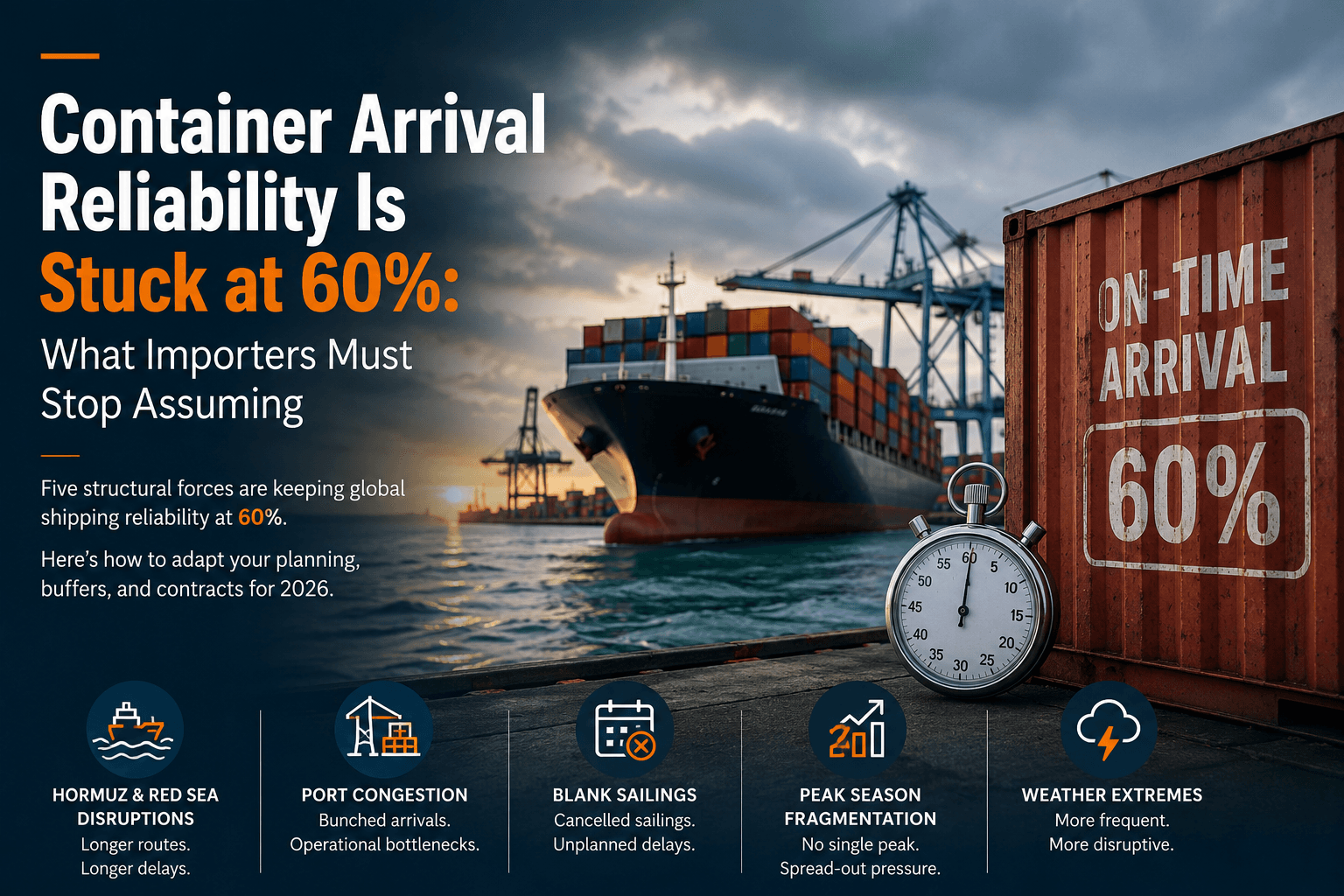
Container arrival reliability has hovered just above 60% since late 2025, far below the historical 75-80% benchmark, and five compounding structural forces mean it isn't recovering soon. Here's what importers — especially those sourcing from India — need to change about inventory buffers, contracts, and replenishment planning.
If your supply chain planning still assumes containers will arrive on schedule most of the time, you are working with the wrong baseline. Container arrival reliability hovered just above 60% in the final months of 2025, according to ING Think's January 2026 Global Trade Outlook - and the report was explicit: "we are not likely to see historical figures of 75-80% anytime soon." That was written before the Strait of Hormuz closed on February 28. It was written before the US-Iran conflict disrupted Gulf shipping entirely. It was written before peak season 2026 arrived early and fragmented across lanes in a way that DC Velocity described as "not moving in one synchronized peak-season market" - published just days ago.
The structural forces keeping global shipping reliability at 60% are not temporary events. They are compounding, overlapping disruptions that have collectively restructured the operating environment for container shipping in ways that will not normalize quickly. Understanding what is driving the reliability gap - and rebuilding your planning assumptions around the 60% reality rather than the 75-80% memory - is the most practical thing an importer can do to protect supply continuity in H2 2026 and beyond.
What 60% Reliability Actually Means for Your Business
Before examining why reliability is stuck at 60%, it is worth being concrete about what that number means operationally.
At 75-80% on-time arrival - the historical benchmark that supply chains were built around - roughly three in four containers arrived within their scheduled window. Procurement teams could plan replenishment cycles, retailer delivery commitments, and manufacturing input schedules with reasonable confidence that shipments would arrive when expected. The 20-25% that arrived late were manageable outliers that safety stock could absorb.
At 60% reliability, two in five containers arrive outside their scheduled window. This is not a manageable outlier rate - it is a structural feature of the market. A food importer with 10 active shipments at any given time should statistically expect four of them to be running late. If your safety stock buffer is calibrated to a 25% late arrival rate, you are systematically underprovisioned for a 40% late arrival environment. Inventory buffer recalibration is not a one-time crisis response at this point. It is a permanent adjustment to how supply chains must be managed until the structural drivers of the reliability gap resolve - and none of them are resolving quickly.
The Five Structural Drivers of the Reliability Gap
1. The Hormuz and Red Sea dual disruption.
The Strait of Hormuz closure from February 28 compounded a Red Sea disruption that had been running since late 2023. Vessels rerouted around the Cape of Good Hope are adding 7 to 14 days to Asia-Europe transit times. Convoy protocols required during Hormuz mine clearance are slowing transits even for vessels now moving through the strait. The two simultaneous detours have removed significant effective capacity from the global fleet - not because ships don't exist but because they are spending more days at sea per voyage and arriving at ports in bunches rather than evenly spaced schedules.2. Port congestion at Northern European hubs.
Rotterdam, Hamburg, Antwerp, and Bremerhaven are all experiencing congestion from disrupted vessel schedules. When vessels arrive in irregular bunches rather than on planned schedules, berth availability, crane allocation, and inland haulage capacity are all strained simultaneously. ING Think's analysis specifically cited congestion at major European container ports as a persistent reliability drag - and the situation has worsened since January 2026 as Cape of Good Hope routing bunches Asia-Europe arrivals at fewer predictable windows.3. Blank sailings and service string restructuring.
Carriers are managing overcapacity concerns in a market where new vessel deliveries continue. BIMCO confirmed approximately 4.4 million TEU of new capacity entering the fleet during 2026-2027. Carriers respond to oversupply with blank sailings - cancelling scheduled departures to support rate levels. For importers, blank sailings produce a specific failure mode: the container is booked, the cargo is at the port, but the vessel does not depart. The shipment misses its scheduled window and rolls to the next available departure, adding 7 to 14 days of unplanned delay with no operational fault on either side.4. Peak season fragmentation.
DC Velocity's analysis published this week confirmed that July 2026 ocean freight is not moving in one synchronized peak-season market. Some lanes are being pulled forward by seasonal demand and tariff anticipation. Others are constrained by service string withdrawals, port omissions, or container shortages. The fragmentation means that reliability statistics that look reasonable at the aggregate level can mask severe reliability problems on specific lanes at specific times. An importer whose key lane is experiencing constraint while the aggregate market looks stable is not helped by aggregate reliability figures.5. The Hormuz deal implementation uncertainty.
The US-Iran agreement signed in Geneva on June 20 provides a path to Hormuz normalization, but the Loadstar reported on July 2 that the Strait of Hormuz is still marked "Closed" in operational terms - consistent with industry guidance that physical normalization takes months, not days. Until the Strait is fully operational and shipping schedules stabilize around restored Gulf routing, the transit time and arrival reliability disruptions from Cape of Good Hope diversions will persist.The Planning Assumptions That Need to Permanently Change
The shipping reliability problem 2026 is not solvable by an importer unilaterally. You cannot make carriers blank fewer sailings or clear port congestion at Rotterdam. What you can do is rebuild your planning assumptions to match the environment that actually exists, rather than the environment that used to exist.
Replace on-time delivery assumptions with probability ranges. Instead of planning around "the container arrives in week X," plan around "the container arrives in a 3 to 4-week window centered on week X." This does not require sophisticated modelling - it requires acknowledging that a 60% reliability environment means your scheduled arrival date is the midpoint of a probability distribution, not a near-certain outcome.
Add 30 to 50% buffer days to every transit time estimate. If your carrier quotes 25 days transit, your planning assumption should be 32 to 37 days. If the quoted transit is 35 days, plan for 45 to 52 days. This sounds conservative. It is calibrated to 60% reliability in a market with active Hormuz disruption, peak season fragmentation, and Northern European port congestion.
Decouple your replenishment triggers from scheduled arrival dates. Procurement systems that trigger the next order when the current shipment is scheduled to arrive will systematically run short at 60% reliability. Replenishment triggers should be based on actual inventory levels against consumption rates, with a buffer that covers the full range of plausible arrival windows - not the scheduled arrival date.
Review force majeure and late delivery clauses in supplier contracts. The frequency of delays in the current environment means that what was once an exceptional force majeure scenario is now a regular operational condition. Review whether your contracts have penalties or remedies for late delivery, whether those penalties apply in the current disruption environment, and whether your supplier relationships are structured to absorb regular delay events without damaging commercial relationships.
What This Means for Indian-Origin Supply Specifically
For importers sourcing from India, the India-to-Europe shipping reliability picture has specific characteristics worth understanding.
Indian ports at Mundra and Nhava Sheva are fully operational. India received a Strait of Hormuz transit exemption during the crisis, meaning Indian-flagged vessels had more routing flexibility than European-flagged carriers throughout the Hormuz disruption period. Cape of Good Hope routing from India to Europe is the established operating model - it was normalized during the 2023-2024 Red Sea crisis and Indian exporters and their freight partners have more operational experience with it than suppliers from origins that only recently adopted Cape routing.
Transit times from Indian ports to Northern Europe via Cape of Good Hope run approximately 28 to 35 days. Applied to the 30 to 50% buffer guidance above, European importers should plan for Indian-origin cargo on 35 to 52-day arrival windows in the current environment. This is longer than the pre-disruption baseline but significantly more predictable than supply chains that route through the Gulf or Suez, both of which carry active schedule disruption risk.
Forward procurement planning from India is particularly effective in this environment. Because India's harvest seasons are predictable - cumin and coriander in February-May, turmeric in February-April, basmati rice harvested October-December - importers who plan forward procurement around harvest windows can combine seasonal price advantages with the logistics certainty of booking well-ahead-of-need shipments. Buying during the harvest flush and accepting the extended transit window produces better economics than spot purchasing against a replenishment trigger that is racing the unreliable arrival of the previous shipment.
At Bayharbor Exports, we work with freight forwarders who are experienced on India-to-Europe Cape routes and provide realistic transit time guidance rather than optimistic schedule estimates. Our logistics partners monitor vessel schedules actively and flag potential blank sailings early enough for importers to adjust. If your current Indian supply chain is producing more late arrivals than your business can absorb, the combination of logistics visibility and forward planning support we offer may be worth discussing. Our FCL vs LCL guide for importers covers the shipping method decision in the current freight environment.