The US-Iran memorandum was signed, but the freight market isn't behaving as if normalization is imminent - and it shouldn't. Here's the real data on Gulf capacity, surcharge timelines, mine clearance, and port congestion that importers need to build an H2 2026 logistics plan around.
The US-Iran memorandum of understanding signed in Geneva on June 20 was a genuine breakthrough - but the freight market is not behaving as if normalization is imminent, and it should not be. The people who understand the shipping industry best are the ones being most measured in their expectations. DHL Global Forwarding told customers to plan for four to six months to full normalization. The International Transport Workers' Federation described the signing as "at best the beginning" of a process. BIMCO, the world's largest international shipping association, continues to run two formal scenarios - one where the Strait fully reopens in Q3 2026 and one where it remains effectively closed through 2026-2027 - because the outcome remains genuinely uncertain even after the agreement.
For importers planning H2 2026 procurement, inventory, and logistics strategies, the question is not whether the agreement is good news - it is. The question is what the freight market actually looks like over the next three to six months, what surcharges will and will not disappear, and how to build a realistic operational plan around the pace of normalization that the industry is actually projecting rather than the pace markets priced in on the day of the announcement.
This blog answers those questions with the most current data available.
Where Freight Capacity Actually Stands Right Now
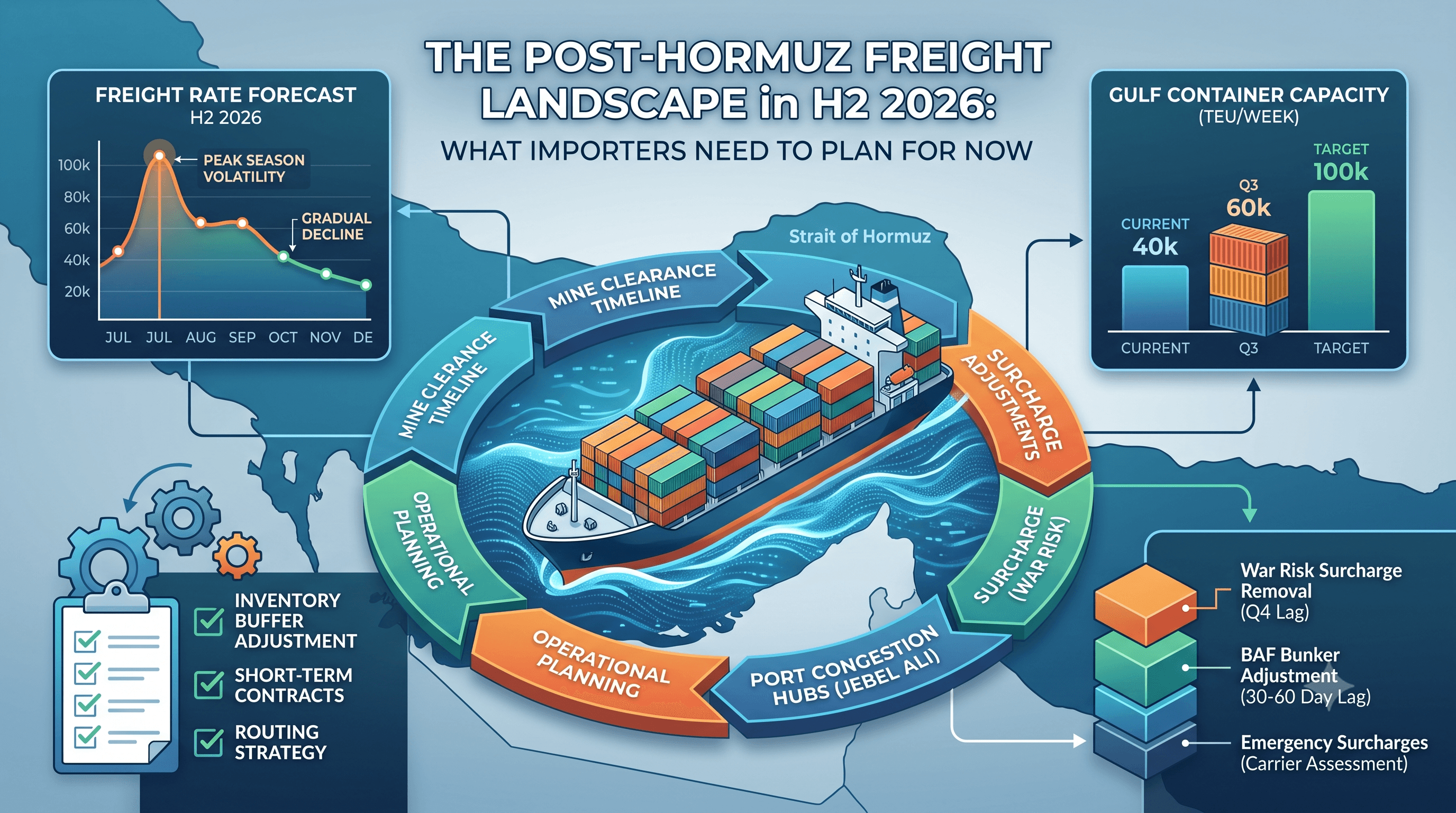
The single most important number for importers to understand is the current Gulf container capacity figure. Available capacity through the Strait of Hormuz corridor is running at approximately 40,000 TEU per week, against a pre-crisis normal of around 100,000 TEU per week. Recovery to 50,000 to 60,000 TEU per week is expected by July - still 40 to 50% below pre-crisis levels. This capacity gap is not a diplomatic problem that resolves when an agreement is signed. It is a physical problem caused by mine clearance timelines, vessel repositioning, crew rest requirements, and infrastructure repair that proceeds on its own schedule.
Container shipping demand has proven more resilient than the supply disruption would suggest. During the first four months of 2026, global container volumes grew by 5.1% year-on-year according to BIMCO, driven by strong intra-Asia trade and exports from East and Southeast Asia to Europe and the Mediterranean. US importers have been front-loading cargo ahead of higher costs - the National Retail Federation's tracker found June was the peak volume month for US imports this year. This demand resilience, combined with constrained capacity, has kept freight rates elevated even as the diplomatic environment improved.
The Platts Container Index rose 80% over the 30 days preceding the agreement announcement, reaching its highest level since April 2022. Transpacific rates are approximately $1,000 per FEU higher than pre-war levels. Asia-Europe freight rates climbed by 10% in the week before the announcement, though prices are now trending down slightly as markets price in the deal.
The Surcharge Structure | What Will and Will Not Disappear Quickly
The container freight surcharges 2026 that importers have been absorbing since March are not a single charge - they are a stack of overlapping adjustments that each have their own removal timeline.
War Risk Surcharges will be the last to disappear. P&I clubs and marine insurers withdrew war-risk cover for the Persian Gulf in early March, and war-risk surcharges were applied industry-wide in response. These surcharges will not be removed until insurers formally downgrade the region's risk profile - a process that requires sustained stability over time, not just a signed agreement. War-risk premium removal typically lags diplomatic developments by two to three months. Importers should plan for war-risk elements in their freight invoices to persist through at least Q3 2026.
Bunker Adjustment Factors (BAF) adjust with a 30 to 60-day lag behind actual fuel price changes. Brent crude fell from the $103 to $113 range to around $83 on the deal announcement, but the BAF update cycle means this fuel cost relief will not appear in freight invoices until 30 to 60 days after the price change is sustained. Importers reviewing invoices in July should begin seeing some BAF relief - but not immediately.
Emergency Conflict Surcharges that carriers applied specifically in response to the Hormuz closure will be removed on a carrier-by-carrier basis as they assess operational conditions. Most carriers will want to see sustained, safe transit before removing these surcharges - meaning June and July shipments will still carry them regardless of the deal.
Peak Season Surcharges of $600 to over $1,000 per FEU have been announced by carriers for mid-June, reflecting the front-loading demand surge ahead of higher July BAF costs. These are independent of the geopolitical situation and will persist through the natural peak season cycle regardless of Hormuz developments.
The net picture: a full normalization of the freight surcharge environment is a Q4 2026 event at the earliest, assuming the agreement holds and physical reopening proceeds without major incidents.
The Mine Clearance Reality
The Strait of Hormuz mine clearance timeline is the hardest physical constraint on normalization speed, and it is the one most likely to be underestimated by importers reading headline coverage of the deal.
Iran laid sea mines in the Strait during the conflict, and the agreement includes a commitment to remove them. Mine clearance is a methodical, safety-critical process that cannot be rushed. Naval convoy escort protocols, required during the removal process, force vessels to travel at regulated speeds in formation - significantly slowing transit even for ships that are nominally "through" the Strait. The US and European allies have naval assets in the region positioned to support the clearance operation, with France confirming its Charles de Gaulle aircraft carrier group is already in the area. But the timeline is measured in weeks of careful operation, not days.
Shipping safety officials told NBC News as recently as June 17 that they "still consider it very risky for ships to commence transits" even after the announcement. The chief safety and security officer at a major shipping industry association stated the reopening would be "a trickle, not a flood." For importers, this means vessels are not going to immediately flood back through the Strait the day after signing - they will trickle back as safety is established and confirmed lane by lane.
The Port Congestion Problem
Even as Hormuz reopens, a second problem is building: port congestion at alternative hubs that served as the overflow system during the crisis.
Jeddah, Khorfakkan, Sohar, Fujairah, and Salalah are all experiencing severe congestion from vessels that rerouted away from the Gulf during the crisis. When Hormuz reopens and Gulf port calls resume, carriers who had been using these alternative hubs will need to rationalize their network - and the vessels currently queuing at congested alternative ports will create a disorderly redistribution of cargo flows that takes weeks to resolve.
Jebel Ali, the UAE's massive transshipment hub that serves as the primary distribution center for the entire Middle East, East Africa, and South Asia, is expected to see a surge of backlogged cargo once operations fully normalize. Cargo that has been sitting at Salalah or Khorfakkan awaiting redistribution will compete for Jebel Ali berths and logistics capacity simultaneously with new imports coming in through the reopened Strait.
For importers with Gulf-destination cargo, this port congestion phase may actually produce more day-to-day operational difficulty than the crisis routing itself - because congestion is unpredictable in a way that an established alternative route is not.
What the H2 2026 Freight Market Actually Looks Like
Putting together the capacity data, surcharge timelines, mine clearance reality, and port congestion dynamics, the H2 2026 shipping outlook breaks into three distinct phases.
June-July 2026: Elevated and volatile. The deal is signed but physical normalization has not begun. Mine clearance is underway. Vessels are trickling back into the Strait under escort. Port congestion at alternative hubs is at its peak. War-risk surcharges remain. BAF has not yet adjusted to lower oil prices. Peak season surcharges are being applied. This is the highest-cost, lowest-predictability phase of the post-deal normalization.
August-September 2026: Gradual improvement. Mine clearance progresses. Gulf port call schedules are being reinstated by carriers who are confident in safety. BAF begins to reflect lower fuel costs. War-risk surcharges start to be reduced on the lowest-risk segments of the corridor. Port congestion at Jebel Ali begins to clear as backlogged cargo is absorbed. Transit times on Gulf-destination routes improve toward 80% of pre-crisis levels. This phase is still more expensive and less reliable than the pre-crisis baseline - but direction of travel is clearly improving.
Q4 2026: Approaching new normal. If the agreement holds and there are no major escalation events, Q4 2026 should see most of the crisis surcharges removed, capacity approaching pre-crisis levels through the Strait, and shipping patterns broadly normalized. BIMCO's SoH Open scenario projects broadly stable supply/demand balance for 2026 before weakening in 2027 as new vessel deliveries flood the fleet. The new normal of Q4 2026 may actually be a favorable freight rate environment for importers as new capacity absorbs demand.
What Importers Should Do Right Now
Do not rush to revert routing decisions. Your carrier has not announced a return to Gulf routing for your specific lane - and until it does, your shipments continue on the Cape of Good Hope routing that has been the standard for the past four months. Reverting prematurely to Gulf routing on the assumption that the deal means immediate normalization creates transit time risk if vessel safety protocols cause delays or the agreement implementation hits friction.
Lock in short-term contract rates now. Spot rates are volatile and currently elevated by front-loading demand. If you have predictable import volume over the next 60 to 90 days, negotiating short-term contract rates now is better economics than competing on spot for space in peak season. Carriers have demonstrated willingness to do short-term fixed-rate agreements to secure volume during uncertainty.
Extend inventory buffers through Q3. DHL's four-to-six-month normalization guidance is the most credible industry benchmark available. Plan for a gradual buffer reduction from 45 to 60 days back toward 30 days over the course of Q3 - not an immediate return to pre-crisis inventory levels.
Monitor the BAF adjustment cycle. If Brent holds below $90 through July, the BAF updates that arrive in your August and September invoices should begin to show meaningful fuel cost relief. Track your carrier's BAF update schedule and flag discrepancies if invoices don't reflect the oil price decline within the expected lag window.