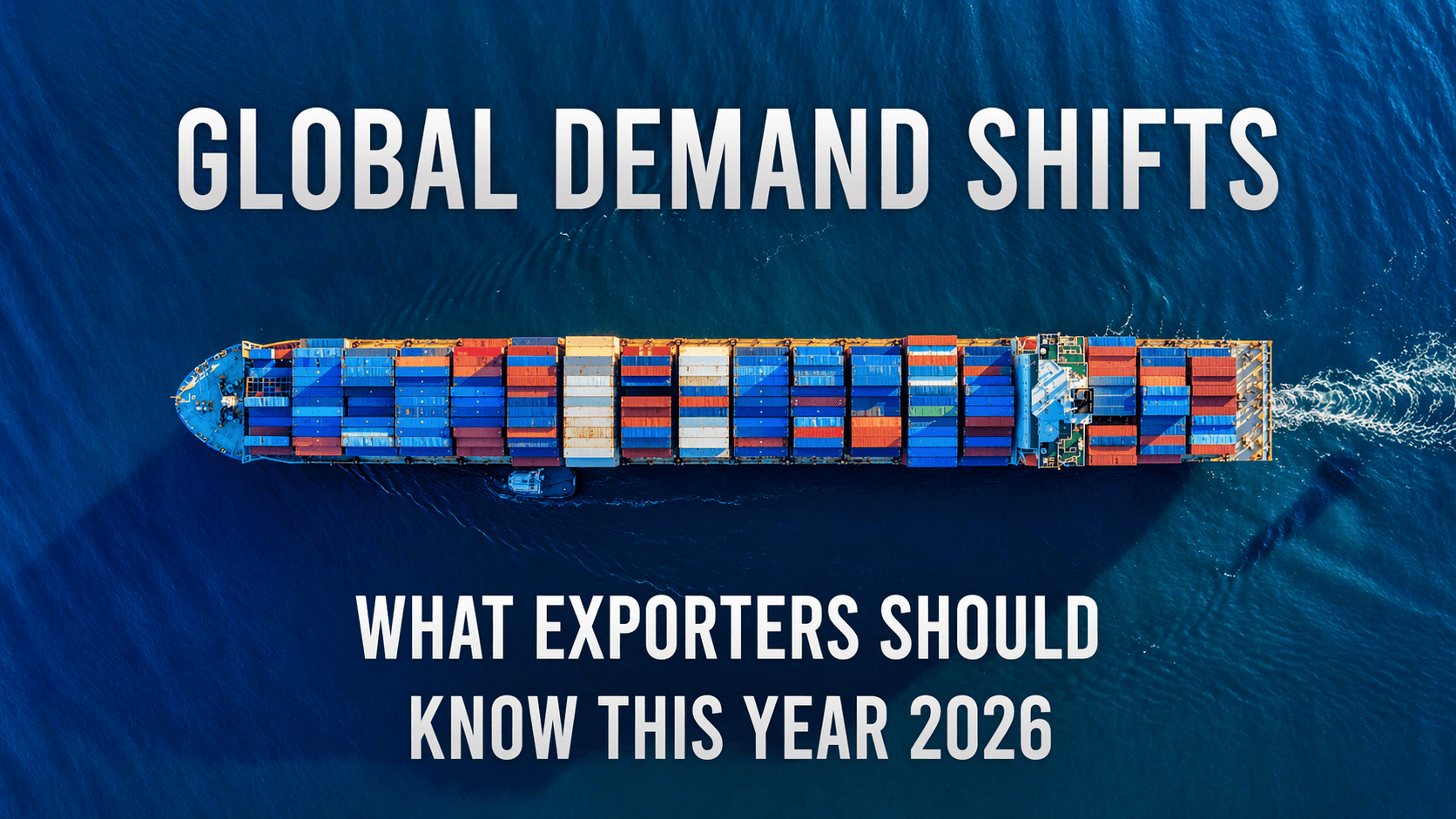
Global trade in 2026 is shifting fast — tariffs, conflicts, and new trade deals are reshaping markets. Here is what exporters need to know to stay competitive.
Navigating Global Trade Shifts in 2026: What Exporters Need to Know | Bayharbor Exports
The global trade landscape in 2026 is unlike anything the world has witnessed in decades. From sweeping tariff overhauls and a historic India-EU free trade deal to escalating Middle East conflict disrupting shipping lanes, exporters and importers are navigating an extraordinary period of transformation. At Bay Harbor Exports, we believe knowledge is your greatest competitive advantage. Here is a comprehensive breakdown of the biggest developments shaping international trade right now — and what they mean for your business.
The World Sets a New Trade Record — Then Slows Down
2025 was a landmark year for global commerce. Preliminary data from the United Nations Conference on Trade and Development (UNCTAD) confirmed that global trade exceeded $35 trillion for the first time, driven primarily by surging demand for AI-enabling products and a wave of import frontloading as businesses raced to stock up ahead of anticipated tariff changes.
However, that momentum is easing significantly. The World Trade Organization forecasts that global merchandise trade growth will slow to just 1.9% in 2026, down sharply from 4.6% in 2025. Combined goods and services trade growth is projected at 2.7% — a clear signal that exporters must sharpen their strategies rather than rely on favorable tailwinds.
For Bay Harbor Exports clients, this means being proactive. Markets that seemed predictable last year are becoming increasingly complex. Countries across Asia, Africa, and South America are still expected to register positive merchandise import growth in 2026, making these regions attractive destinations for well-positioned exporters.
The U.S. Trade Landscape: Deficits, Tariffs, and Policy Shifts
The United States recorded a goods trade deficit of $1.24 trillion in 2025 — the highest level ever recorded — even as sweeping tariffs were in place. This paradox reveals something important: tariffs alone do not automatically rebalance trade. Instead, they often redirect sourcing rather than reduce it.
The most recent data from the U.S. Bureau of Economic Analysis shows that the goods and services deficit stood at $57.3 billion in February 2026, with exports reaching $314.8 billion. Year-to-date, the goods and services deficit has actually decreased by 54.8% compared to the same period in 2025 — a sign that export performance is strengthening.
On the policy side, significant changes are underway. The U.S. Supreme Court recently issued a landmark ruling finding that the administration’s use of the International Emergency Economic Powers Act (IEEPA) to impose broad tariffs exceeded statutory authority. This triggered a rapid pivot to a 10% global tariff on all imports under Section 122 of the Trade Act of 1974 — a measure limited to 150 days unless extended by Congress. Additionally, a new proclamation issued on April 2, 2026, strengthened Section 232 tariff actions on imports of aluminum, steel, and copper, citing national security concerns.
For exporters, these policy shifts create real uncertainty — but also real opportunity. Businesses that understand the evolving framework and adapt their supply chains accordingly can gain a competitive edge.
The India-EU Free Trade Deal: A Game-Changer for Global Commerce
One of the most consequential trade developments of the year is the landmark free trade agreement signed between India and the European Union at the end of January 2026 — a deal that took two decades to negotiate. The agreement creates the world’s largest free trade zone, encompassing two billion people and nearly 25% of global GDP.
For Bay Harbor Exports and our clients, this deal opens significant new pathways. Goods flowing between India and Europe will face reduced barriers, creating opportunities for re-export strategies, joint manufacturing ventures, and supply chain optimization. Sectors likely to benefit include pharmaceuticals, textiles, engineering goods, agricultural products, and digital services.
Businesses that position themselves at the intersection of Indian manufacturing strength and European market access are well-placed to capture significant growth over the coming years.
Middle East Conflict and the Shipping Crisis
The ongoing Middle East conflict has introduced severe disruption to some of the world’s most critical trade corridors. Oil and gas prices surged following military strikes on Iran, with Brent crude briefly rising above $82 a barrel. Approximately 20% of global oil and a similar share of liquefied natural gas typically transit the Strait of Hormuz — and with vessels dropping anchor and ports suspending operations across the region, supply chains are under sustained pressure.
The WTO has warned that elevated energy prices throughout 2026 could shave 0.5 percentage points off the merchandise trade forecast and slow services trade growth to 4.1%. Transport and logistics costs have increased, timelines have stretched, and cargo insurance premiums have climbed.
At Bay Harbor Exports, our logistics and routing teams continuously monitor these developments. We help clients identify alternative shipping routes, pre-position inventory, and structure contracts that account for force majeure disruptions in high-risk corridors.
WTO at a Crossroads: The Fight for Multilateral Trade Rules
In late March 2026, the World Trade Organization held its 14th ministerial conference in Yaounde, Cameroon, in what has been called a make-or-break moment for the multilateral trading system. WTO Director-General Ngozi Okonjo-Iweala warned that the organization faces the threat of “disorderly collapse” if member nations cannot agree on meaningful reforms.
The core dispute centers on the Most Favoured Nation (MFN) principle — which governs 72% of global trade — and whether it remains fit for purpose in a world of geopolitical fragmentation, industrial policy rivalry, and escalating protectionism. More than 3,000 new trade and industrial policy measures were introduced globally in 2025, more than three times the annual level recorded a decade ago.
This fragmentation has real implications for exporters. A world of bilateral deals and variable tariff frameworks is harder to navigate than a rules-based system — but it also rewards businesses with the expertise, networks, and agility to operate across different regulatory environments. That is precisely where Bay Harbor Exports adds value.
Green Trade and the EU Carbon Border Mechanism
From 2026, the European Union’s Carbon Border Adjustment Mechanism (CBAM) begins to bite in earnest. This policy places a carbon price on imports of certain goods — initially covering cement, iron, steel, aluminum, fertilizers, electricity, and hydrogen — based on the carbon emissions embedded in their production. Exporters to the EU must now account for their carbon footprint as part of their compliance and pricing strategy.
Simultaneously, clean energy technology markets are forecast to reach $640 billion annually by 2030. Trade in green goods and services is accelerating, and countries that position themselves as suppliers of clean technology, critical minerals, and sustainable agricultural products will be best placed for long-term growth.
Bay Harbor Exports works with clients to map their supply chains’ carbon exposure, ensure compliance with EU CBAM requirements, and explore new opportunities in the growing global green economy. ^^ Frequently Asked Questions (FAQ) How does Bay Harbor Exports help businesses navigate the new U.S. tariff environment?
We provide detailed tariff classification analysis, duty drawback recovery support, and strategic sourcing advice that helps clients minimize tariff exposure while maintaining supply chain efficiency. Our team monitors regulatory changes daily so your business never operates on outdated information.
Can Bay Harbor Exports help me access the India-EU free trade zone opportunities?
Absolutely. We have established trade relationships and logistics networks across India, the EU, and connecting markets. Whether you want to export into the EU via Indian manufacturing, or supply Indian markets through European partnerships, we can structure solutions that work for your specific product category.
How is Bay Harbor Exports managing the Middle East shipping disruptions? Our logistics team actively monitors corridor risks and maintains relationships with multiple carrier networks. We offer alternative routing through the Cape of Good Hope and trans-Pacific options, and can advise on appropriate cargo insurance and force majeure contract clauses.
What is the EU Carbon Border Adjustment Mechanism and does it affect my exports? The CBAM applies to goods exported to the European Union in certain regulated sectors. If you export steel, aluminum, cement, fertilizers, or electricity to EU markets, you will need to report and potentially pay for the carbon embedded in those goods. Bay Harbor Exports can help you assess your exposure and develop a compliance strategy.
Is 2026 still a good time to expand into international markets? Yes — with the right preparation. While growth is slowing from 2025’s record levels, significant opportunities remain, particularly in Asia, Africa, and South America. The India-EU free trade deal and the expansion of clean energy markets create new avenues for exporters. Bay Harbor Exports specializes in helping businesses identify, enter, and succeed in high-potential markets.
How can I get started with Bay Harbor Exports?
Yes — with the right preparation. While growth is slowing from 2025’s record levels, significant opportunities remain, particularly in Asia, Africa, and South America. The India-EU free trade deal and the expansion of clean energy markets create new avenues for exporters. Bay Harbor Exports specializes in helping businesses identify, enter, and succeed in high-potential markets.
How can I get started with Bay Harbor Exports? Contact our team today for a no-obligation consultation. We work with businesses of all sizes — from first-time exporters to established multinationals — to develop trade strategies that are tailored, compliant, and commercially effective.
Bay Harbor Exports is a full-service international trade partner dedicated to helping businesses grow beyond borders. From tariff strategy and customs compliance to freight forwarding and market entry, we are with you every step of the way. © 2026 Bay Harbor Exports. All rights reserved.