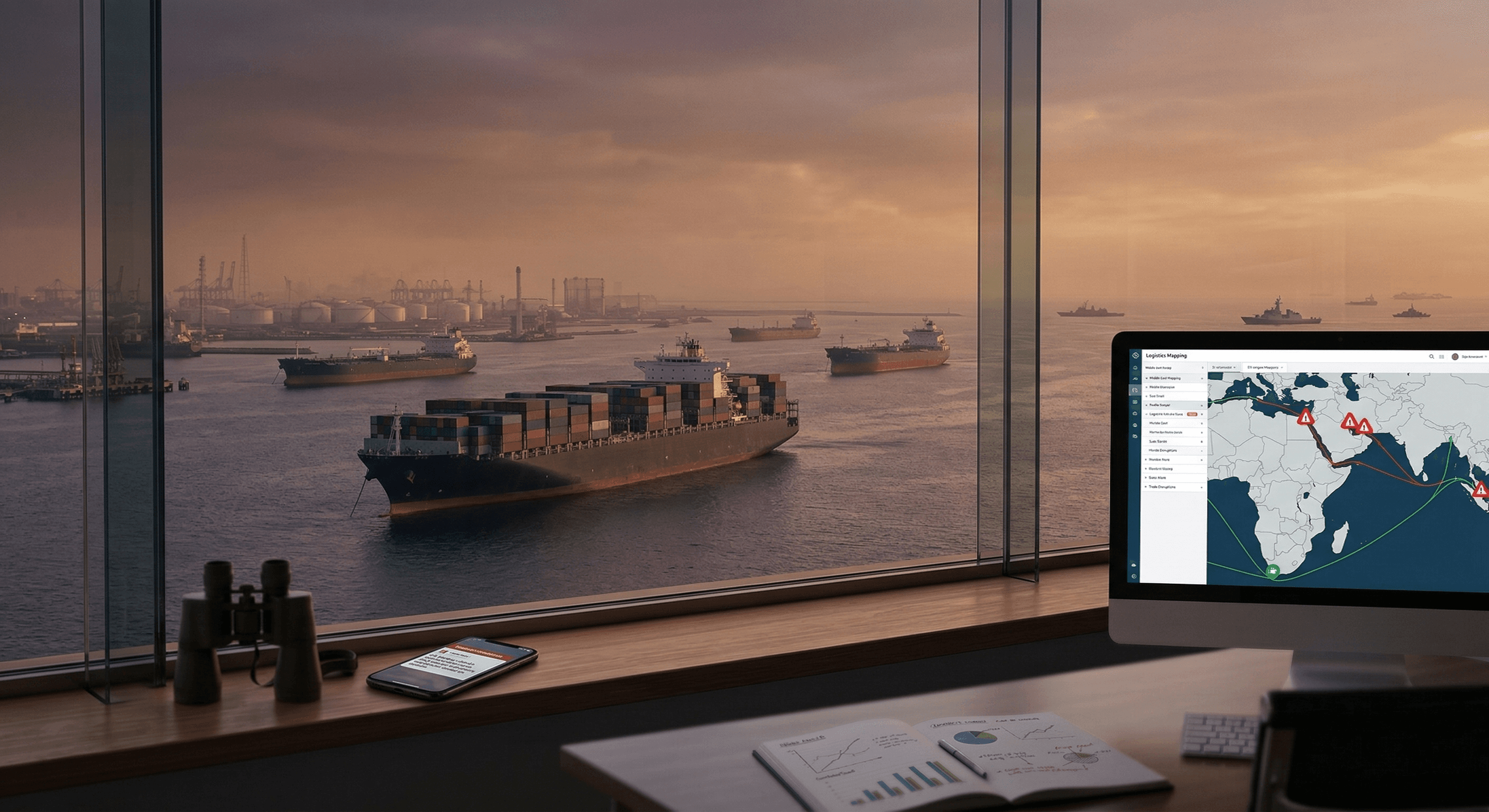
The Middle East conflict has closed the Strait of Hormuz, suspended Suez transits, and shut Gulf airspace. Here is a clear breakdown of what it means for global trade right now.
The Middle East Conflict and Global Trade: What Every Importer Needs to Know
On February 28, 2026, what began as a targeted military operation rapidly expanded into the most significant global supply chain disruption since the COVID-19 pandemic. Within 48 hours of the US and Israeli strikes on Iran, the Strait of Hormuz was effectively closed, Suez Canal transits were suspended by every major shipping line, Gulf airspace was shut across the UAE, Qatar, Kuwait, Bahrain, and Iraq, and Jebel Ali - the world's largest man-made port and the logistics backbone of the entire Middle East - had temporarily suspended operations after drone strikes caused a fire at its berths.
"The speed and scope of escalation in the Middle East will have taken many businesses by surprise," said Simon Geale, EVP at Proxima, "and has highlighted just how unstable the region can become in as little as 48 hours."
This blog is a clear-eyed breakdown of what has actually happened, how it is affecting global trade across every major region, and what procurement professionals should be doing right now.
What Happened in the First 72 Hours
The sequence of events moved faster than most contingency plans had anticipated. US and Israeli strikes on February 28 targeting Iranian military, nuclear, and leadership infrastructure triggered immediate Iranian retaliation - missile strikes on Gulf neighbors including the UAE, Saudi Arabia, and Qatar, and the activation of the Islamic Revolutionary Guard Corps naval forces in the Persian Gulf.
The IRGC transmitted radio warnings to commercial vessels in the Strait of Hormuz stating that no ships would be permitted to pass. Around 150 vessels - container ships, tankers, and bulk carriers - dropped anchor in the waterway rather than risk transit. At least five tankers were struck near the strait. Protection and indemnity insurance was withdrawn for Persian Gulf transits effective March 5, meaning the economic risk became too high for most ship owners to continue operations regardless of their operational willingness.
The response from major carriers was swift and far-reaching. MSC declared an "End of Voyage" for all containerized cargo destined for ports inside the Arabian Gulf - a rare and legally consequential step that effectively shifted risk and cost onto cargo owners. Maersk suspended all vessel transits through the Strait until further notice. Hapag-Lloyd suspended all Strait transits and warned of rerouting, delays, and war-risk surcharges. CMA CGM instructed all Gulf-bound vessels to proceed to shelter areas and suspended certain bookings. FedEx suspended flights to Bahrain, Iran, Iraq, Israel, Jordan, Kuwait, Lebanon, Oman, Qatar, the UAE, and Saudi Arabia simultaneously.
On February 28, missile strikes and retaliatory attacks rapidly expanded into a broader regional crisis, prompting the closure of the Strait of Hormuz, a suspension of Suez Canal transits, and widespread airspace restrictions across Gulf states - quickly evolving into one of the most significant supply chain shocks since the Red Sea crisis.
The Scale of What Is at Stake
To understand why this crisis hits global trade so hard, you need to understand the numbers behind the waterways and hubs now disrupted.
The Strait of Hormuz handles around 20% of global seaborne oil and a similar share of LNG. Every barrel produced by Saudi Arabia, Iraq, the UAE, Kuwait, and Qatar must pass through it to reach global markets. There is no adequate maritime alternative - existing bypass pipelines can handle only about 4.2 million barrels per day out of the 20 million that normally transit the Strait. Brent crude rose as much as 13% in early trading on March 2, briefly above $82 a barrel, as traders reacted to disrupted flows from the Gulf.
Jebel Ali port in Dubai normally processes over 15 million TEUs per year and serves as the primary transshipment hub for goods moving between Asia, Europe, and Africa. Its partial suspension didn't just affect Middle East-bound cargo - it disrupted the flow of containers that normally use Gulf ports as waypoints on longer trade routes.
The Islamic Revolutionary Guard Corps issued radio warnings prohibiting vessel passage through the Strait, reportedly trapping nearly 170 container ships and halting movement of 20% of the world's seaborne oil supply. Roughly 10% of the global container fleet was caught in the regional disruption during the early stages of the crisis.
How Different Regions Are Being Hit
The Middle East conflict trade impact is not uniform across the world. Different regions face different vulnerabilities depending on their energy dependence, trade routing, and inventory positions.
most-exposed-on-energy" class="scroll-mt-24 text-xl sm:text-2xl font-bold mt-8 sm:mt-12 mb-3 sm:mb-5 text-gray-900 border-l-4 border-blue-400 pl-3 sm:pl-4">Asia - Most Exposed on EnergyAsia absorbs the majority of Gulf crude exports - China, India, Japan, and South Korea together account for nearly 70% of Strait crude shipments. China, which sourced roughly 14% of its oil from Saudi Arabia and 7% from the UAE as of 2025, faces acute near-term supply pressure despite its significant strategic reserves. India's position is equally difficult - and the country is already feeling secondary effects. More than 400,000 metric tons of basmati rice grown in India for export are stuck at Indian ports or in transit as the war disrupts shipping lanes across the Middle East, with roughly 75% of India's annual basmati rice exports going to the region.
Pakistan, Bangladesh, and India each sourced 59% or more of their LNG imports from Qatar and the UAE - supply that is now severely disrupted. South Asia faces the most acute near-term LNG exposure of any region.
gas-and-routing-vulnerability" class="scroll-mt-24 text-xl sm:text-2xl font-bold mt-8 sm:mt-12 mb-3 sm:mb-5 text-gray-900 border-l-4 border-blue-400 pl-3 sm:pl-4">Europe - Gas and Routing VulnerabilityEurope's primary vulnerability is natural gas rather than crude oil. European natural gas futures jumped around 30% in the first days of the crisis. Consumer price inflation in the EU - which stood at 2% in January - could rise by more than a percentage point if the conflict drags on for several months, according to Holger Schmieding, chief economist at Berenberg bank.
The routing disruption compounds the energy price pressure. If carriers avoid the Suez Canal and Bab el-Mandeb and instead reroute around the Cape of Good Hope, Asia-Europe transit times will be longer and less reliable. European retailers and manufacturers who normalized supply chains following the 2023-2024 Red Sea crisis now face a second and more severe rerouting event on the same corridor.
indirect-but-real" class="scroll-mt-24 text-xl sm:text-2xl font-bold mt-8 sm:mt-12 mb-3 sm:mb-5 text-gray-900 border-l-4 border-blue-400 pl-3 sm:pl-4">United States - Indirect but RealThe US is the world's largest crude producer and a net LNG exporter, which insulates it from direct supply disruption. However, if oil prices stay at current levels for several months, US consumer price inflation could rise from 2.4% in January to 3% by the end of the year, Goldman Sachs said. US gasoline prices hit their highest level in 11 months in the first week of March, wiping out all the consumer-side progress on energy costs during the current administration.
freight-rate-exposure" class="scroll-mt-24 text-xl sm:text-2xl font-bold mt-8 sm:mt-12 mb-3 sm:mb-5 text-gray-900 border-l-4 border-blue-400 pl-3 sm:pl-4">Africa - Freight Rate ExposureAfrican ports receive most imports from China, India, and Southeast Asia - they will feel the impacts of pressure in major Asian hubs relatively quickly. The biggest near-term risk to Africa is the immediate impact of increased freight rates as the system adjusts to reduced and disrupted capacity overall.
The Cascading Effects Beyond Energy
The Middle East conflict supply chain impact extends well beyond oil and gas. Several second-order effects are now building across industries.
Fertilizer and Agriculture
The Strait of Hormuz blockage threatens nitrogen fertilizer exports ahead of Northern Hemisphere spring planting. Prolonged disruption could trigger shortages in South Asia and Latin America, causing crop yield drops for late 2026 and food price spikes. Natural gas is the primary feedstock for nitrogen fertilizer production, and with LNG flows from Qatar severely disrupted, fertilizer production costs are rising in real time across importing regions.
Technology and Semiconductors
Just-in-time delivery for microchips and consumer tech is severely disrupted - EV batteries and semiconductors for 2026 production are stranded in the Gulf. Regional data infrastructure is also under pressure, with Microsoft Azure and AWS investigating reported latency spikes at Middle Eastern nodes following missile strikes on Dubai and Doha data center hubs.
Air Freight
Aircraft redeployments, route extensions, and service suspensions are tightening available capacity across key trade lanes globally. Global air cargo capacity dropped 18% in the first week of the crisis. The Gulf air corridor - which sits at the intersection of Europe-Asia and Europe-Africa flight paths - is essentially closed, forcing airlines onto longer routes with higher fuel costs and reduced payload capacity. If overflight paths through the Middle East are restricted, long-haul cargo flights may need to take longer alternative routes, increasing transit times and costs with particularly significant impacts on pharmaceutical shipments.
Insurance and War Risk Premiums
Major P&I clubs - including Gard, Skuld, NorthStandard, London P&I Club, and American Club - have announced the termination of war-risk cover for ships operating in the Persian Gulf and the Strait of Hormuz, effective around March 5, 2026. The Joint War Committee has expanded the designated high-risk zone to include waters around Bahrain, Kuwait, Qatar, Oman, and the Arabian Gulf approaches. This insurance withdrawal is arguably more consequential than the military situation itself - without insurance, most commercial operators cannot legally or financially move vessels through the region regardless of their willingness to do so.
The Bottom Line
The Middle East conflict global trade disruption is real, immediate, and broader than most procurement teams had contingency plans for. The closure of the Strait of Hormuz, the suspension of Suez transits, the shutdown of Gulf airspace, and the withdrawal of marine war-risk insurance have simultaneously removed multiple arteries from the global logistics network.
How long this lasts determines how severe the economic consequences become. A resolution within weeks produces a significant but temporary disruption. A conflict extending beyond six weeks, with sustained tanker harassment and continued Strait disruption, produces a supply shock of a different order entirely - one that feeds through into inflation, interest rates, and global growth in ways that will be felt well into 2027.
The businesses that will navigate this best are those who audit their current exposure, secure alternative capacity immediately, and use this crisis as a forcing function to build the supply chain resilience that most had been deferring. The window for doing that cheaply has passed. The window for doing it at all is still open.